
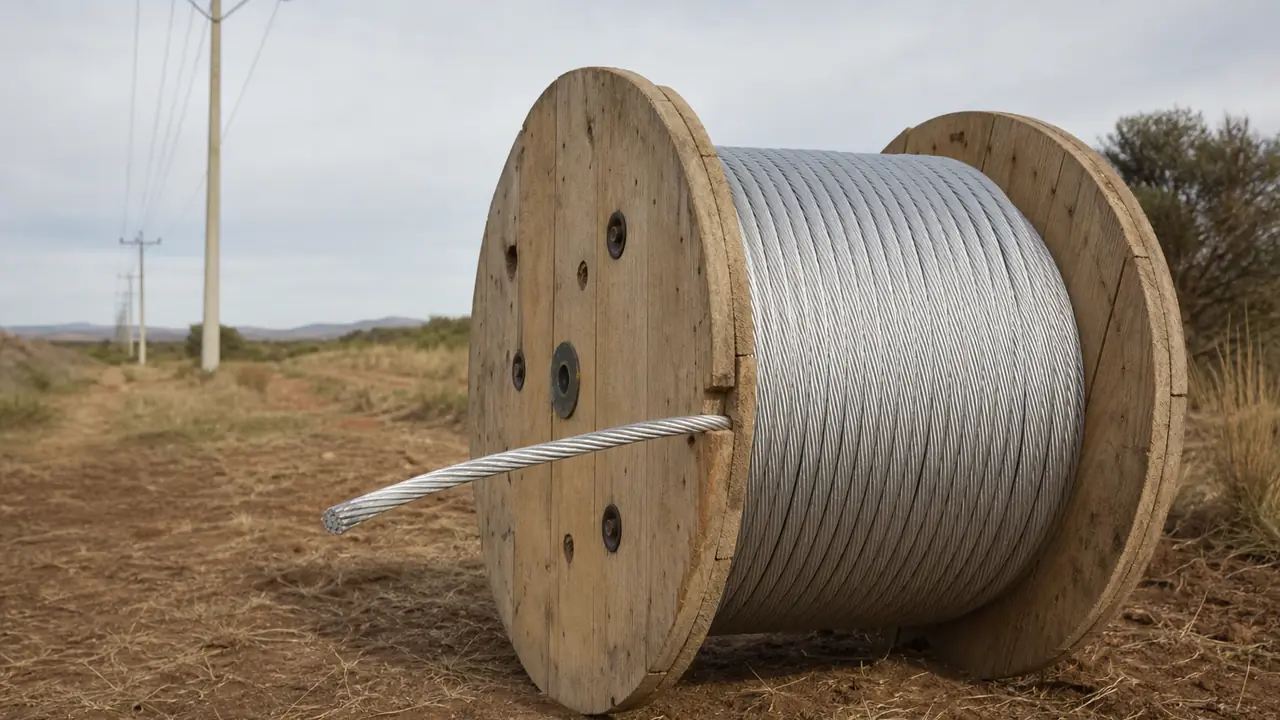
What bare overhead conductors are
Bare overhead conductors are uninsulated stranded conductors strung between poles and towers: the air gap is the insulation, so the conductor carries the whole electrical and mechanical duty. Three families cover most distribution work. ACSR, aluminium conductor steel reinforced, wraps hard-drawn aluminium layers around a galvanised steel core and is the general default for rural distribution and subtransmission. AAC is all-aluminium conductor, and AAAC is an aluminium alloy conductor with no steel at all. The reference figures on this page come from public datasheets; confirm every value on the datasheet of the plant that makes your order.
The smallest common reference row is the 6/1 Turkey class: about 13.3 mm2 of aluminium area (26.2 kcmil), 1.68 mm wires of both aluminium and steel, an overall diameter of about 5.0 mm, about 53.7 kg/km and a DC resistance of about 2.10 ohm/km at 20 C. Mid and large classes scale up through the 26/7 construction to the 54/7 rows used on longer spans.
The three ACSR strand classes
The numbers describe the lay-up: 6/1 is six aluminium wires over a single steel wire, while 26/7 and 54/7 are two and four aluminium layers over a seven-wire steel core. Public datasheets give reference rows like these.
| Class | Lay-up | Reference row | Wires | OD | Weight |
|---|---|---|---|---|---|
| 6/1 | 1 steel wire, 1 aluminium layer | Turkey, approx. 13.3 mm2 (26.2 kcmil) | 1.68 mm aluminium and steel | 5.0 mm | approx. 54 kg/km |
| 26/7 | 7-wire core, 2 aluminium layers | Linnet, approx. 170.5 mm2 (336.4 kcmil) | 2.89 mm aluminium, 2.25 mm steel | 18.3 mm | approx. 689 kg/km |
| 54/7 | 7-wire core, 4 aluminium layers | Crow, approx. 362 mm2 (715.5 kcmil) | 2.92 mm aluminium and steel | 26.3 mm | approx. 1,371 kg/km |
Codenames are buying language: order by construction and area, with the codename in brackets.
ACSR vs AAC vs AAAC
| Family | Aluminium | Core | Standards | Where it fits |
|---|---|---|---|---|
| AAC | 1350-H19 hard drawn | None | ASTM B231; IEC 61089 | Short spans and city feeders; high conductivity for the weight |
| AAAC | 6201-T81 alloy | None | ASTM B398/B399; IEC 61089 | Coastal and corrosive routes; no steel to corrode; strength between AAC and ACSR |
| ACSR | 1350-H19 hard drawn | Galvanised steel, 6/1 to 54/7 | ASTM B232; BS EN 50182 | Longer spans and heavier loads; the general default |
AAAC exists largely for corrosion: with no steel core there is nothing to rust at the aluminium-steel interface, which is why coastal and industrial atmospheres often point to the alloy, and datasheets pair an alloy row with an ACSR row of equal resistance so buyers can switch families without redesigning the circuit. For the metallurgy behind 1350-H19 and 6201-T81, see conductor materials.
A trap worth naming: the same aluminium area is available in different steel ratios. At one 336.4 kcmil class, 18/1, 26/7 and 30/7 strandings all exist, and their rated strengths differ by roughly a factor of two across the range. Always specify the stranding together with the area.
Rated tensile strength and span are line-design values
Rated tensile strength is not one number per size. It is defined by the applicable standard and stated on each manufacturer datasheet for the exact construction: the 6/1 reference row above lists about 5.3 kN, other constructions list other figures, and the same area in a different steel ratio lists a different value again. Treat it as a datasheet property of the construction you order, not as a working tension, and never as permission to pull harder during stringing.
Span length is decided by the line designer, not by the conductor catalogue: support spacing, sag, everyday tension, wind and ice loading and temperature all enter the sag-tension calculation for the route. The desk does not quote typical spans and does not choose them. For the same reason we do not publish current ratings: datasheet columns are calculated under particular weather assumptions, and the rating for your route is confirmed by the line designer. The cable sizing guide explains how these inputs work in general.
Standards and how to write the enquiry
The North American system runs on ASTM: B230 for hard-drawn aluminium wire, B231 for AAC, B232 for ACSR and B398/B399 for the 6201 alloy. IEC 61089 covers stranded overhead conductors, and BS EN 50182 brings the European designations, in which the 54/7 class above is written 363-A1/S1A-54/7: A1 for hard-drawn aluminium, S1A for strength class 1, class A galvanised steel. A clean enquiry names construction, area, coating class and both designations where the project spans both systems; that removes most quoting ambiguity.
What you can change, and what you should not
- Steel core coating: class A or AB zinc, per the route's corrosion duty; fixed with the construction.
- Grease: dry as standard; core grease or fully greased conductor as options for corrosive routes.
- Reel and length: coil or reel, and metres or feet per reel, agreed on the reel plan.
- Stranding and area: set by your line design; the desk does not substitute one class for another.
Reels, MOQ and how the desk quotes
Small classes ship in coils; packaging tables list around 5,400 ft per coil for the 6/1 reference class. Larger classes go on wooden reels, with 60-96 in reel diameters common across packaging tables. Ask for length per reel and gross weight, because freight follows reel weight. MOQ and lead time are set per size and confirmed in writing for each order; see MOQ and lead time and packaging and drums. Every reel carries a tag with construction, batch and length, and the desk collects the test certificate per reel; see testing and inspection. Send the construction, area, total metres and destination port through the quote form.