
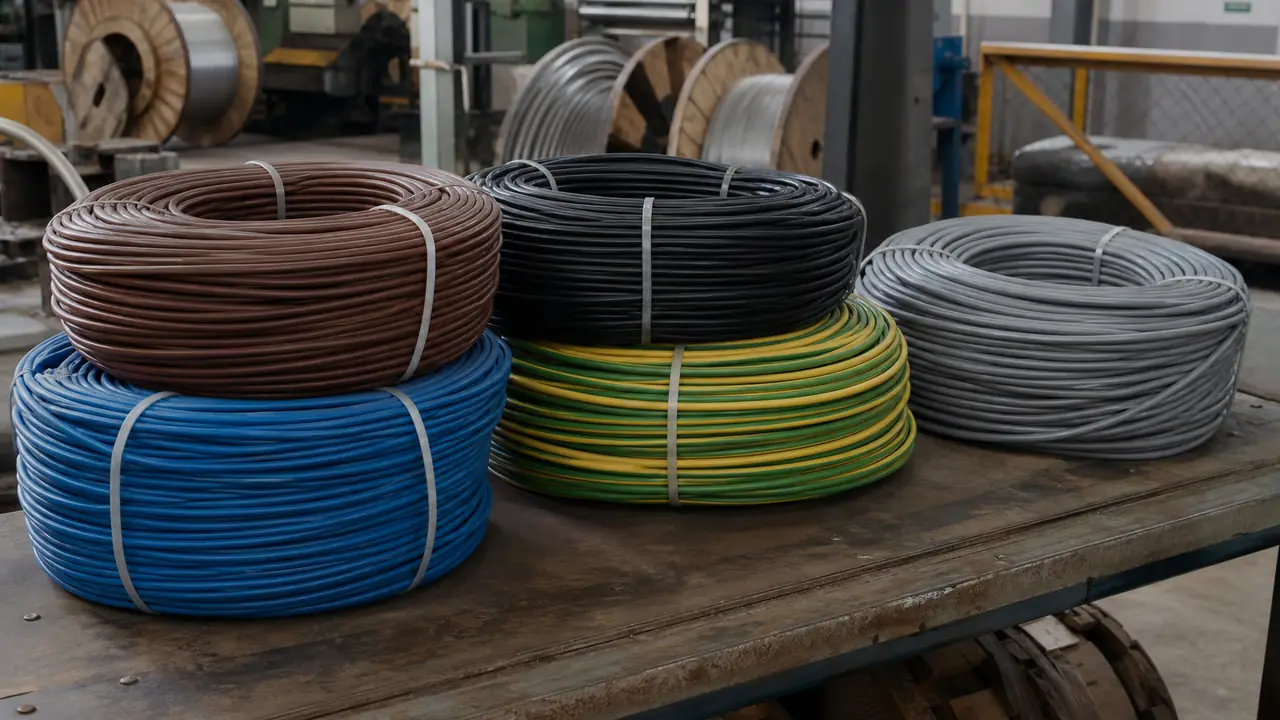
What sits in this family
Building and control cables are the low-voltage wiring that sits downstream of the power cable. A 0.6/1 kV LV power cable brings power to the distribution board; from there, building wire runs in conduit to sockets and lights, flexible cords connect appliances and portable equipment, control cables carry switching signals between panels, motors and valves, and instrumentation cables carry low-level measurement signals that need a screen against interference. All four use annealed copper conductors to IEC 60228, mostly PVC insulation, and voltage ratings of 300/500 V or 450/750 V in IEC markets. Their reference constructions on the line pages come from a partner plant catalogue.
They are also the lines where buyer types diverge most. A hardware retailer wants 100 m coils of 2.5 mm2 wire in shelf-ready packs; an EPC contractor wants 19-core control cable cut to drum lengths from a cable schedule; a brand owner wants private-label cords with its own print. The desk asks for the designation and standard first, because the same words mean different products in different markets.
Choosing among the four lines
| Line | Reference model | Category range | Typical use |
|---|---|---|---|
| Building wire | 450/750 V PVC single core 2.5 mm2 (60227 IEC 01 / H07V-R type) | 1.5-400 mm2; Class 1, 2 or 5; THHN/THWN-2 and XHHW-2 for the US | Fixed wiring in conduit, trunking and panels |
| Flexible cords | 300/500 V 3x1.5 mm2 PVC cord (60227 IEC 53 / H05VV-F type) | 2-5 cores, 0.75-2.5 mm2 | Appliances, extension leads, portable equipment |
| Control cables | 450/750 V Cu/PVC/PVC 7x1.5 mm2 (KVV type) | 2x0.75 up to 61x2.5 | Switching, interlocks, motor control circuits |
| Instrumentation cables | 450/750 V 4x1.5 mm2 with overall braid screen (KVVP type) | Overall screen 2x0.75 up to 44x1 | Sensor and measurement signals in plants |
A simple rule: if the conductor goes into conduit or trunking on its own, it is building wire; if it moves or plugs in, it is a cord; if many cores carry switching between equipment, it is control cable; if the signal is low-level and noise matters, it is instrumentation cable with a screen.
US, IEC, Thai and UK building wire are different products
Building wire is the line where markets disagree most, and the systems are not interchangeable on a label or a spec sheet.
- United States: sizes in AWG; THHN/THWN-2 to UL 83 (PVC insulation with a nylon jacket) and XHHW-2 to UL 44 (XLPE insulation). NEC 310.3 sets 14 AWG as the minimum copper size for building wiring. US projects usually require UL (or other NRTL) listed products to satisfy the AHJ, so the listing held by the partner plant for that construction is checked per order. AWM wire to UL 758 is not field wiring.
- IEC markets, EU and Middle East: sizes in mm2; 60227 IEC 01 wire sold as H07V-U (solid), H07V-R (stranded) or H07V-K (flexible). In the EU, wire permanently installed in buildings needs a CPR class declared on the DoP.
- Thailand: TIS 11 follows the IEC 60227 split; Part 3 (unsheathed, fixed wiring) and Part 4 (sheathed, fixed wiring) have been mandatory since 30 July 2013. The desk works with a southwest China partner plant that has TIS 11 model experience; see Thailand TIS 11 cables.
- United Kingdom: single cores and flat twin and earth to BS 6004 (6242Y PVC) or BS 7211 (6242B LSZH). Only cable printed with the BASEC name is a BASEC approved product.
Control or instrumentation cable
Control cable switches things: contactor coils, solenoid valves, limit switches and interlocks, typically at mains or 24 V control voltage, with numbered cores so electricians can terminate long multicore runs without mistakes. Instrumentation cable measures things: 4-20 mA loops, thermocouples and other low-level signals that pick up noise from nearby power cables, so it adds a screen. The reference KVVP-type construction has a polyester tape and a copper wire braid as an overall screen. Individually screened pairs (EN 50288-7 or PAS 5308 types) are outside the partner catalogue behind this reference and are matched to a separate plant. The control vs instrumentation cable article goes further.
What the desk checks on these lines
Small conductors are where undersizing hides. On every line the desk asks for conductor DC resistance at 20 C against IEC 60228, for example 7.41 ohm/km for 2.5 mm2 Class 1 or 2 copper and 13.3 ohm/km for 1.5 mm2 Class 5, plus insulation and sheath thickness and overall diameter. Core colours and core numbering are checked against the spec sheet, and coil labels or drum tags against the packing list. Current rating is never quoted: it depends on the installation method under IEC 60364-5-52, BS 7671 or NEC as applicable, confirmed by the project engineer.
Packing and ordering
Building wire and cords usually ship in 100 m coils, which suits retail and distribution; coil length, shrink wrap and carton labels are set on the spec sheet. Control and instrumentation cables ship on wooden or steel-wood drums, and plant listings commonly show around 1,000 m per size for control cable. MOQ and lead time are confirmed in writing for each order; see MOQ and lead time, or send your sizes and metres through the quote form.