


Start from the job, not the catalogue
A cable order goes wrong most often at the very start, when a buyer describes a product instead of a circuit. 'Four-core armoured cable' can mean a BS 5467 steel wire armoured cable for a UK plant room, an IEC 60502-1 steel tape armoured cable for a Middle East villa compound, or a cable that the site never needed armour on at all. The desk therefore asks what the cable does: which circuit, which installation method, which standard the engineer has written into the specification and how the cable will be delivered to the pulling point. The six application pages below translate those questions into lines, constructions, standards and drum plans.
The pages are written for brand owners, distributors and wholesalers who supply contractors as well as for engineering projects buying direct. They do not size cables. Conductor size and current rating depend on installation method, grouping, ambient temperature, voltage drop and fault level under IEC 60364-5-52, BS 7671 or the NEC as applicable, and are confirmed by the project engineer. The cable sizing guide lists the inputs the engineer will need.
Six project types and the lines they use
| Project type | Main lines | Key standards | Typical packing |
|---|---|---|---|
| Buildings | Building wire, LV power, fire-resistant, flexible cords, LAN | IEC 60227, IEC 60502-1, EN 50575, BS 6004, TIS 11 | 100 m coils, drums, 305 m boxes |
| Solar PV farms and roofs | Solar PV cable, LV and aluminium power, armoured, MV | EN 50618, IEC 62930, UL 4703, IEC 60502-1/-2 | 100 m coils, 500 m drums, large drums |
| Industrial plants | Armoured, control, instrumentation, LV power, fire-resistant | IEC 60502-1, BS 5467, BS 6724, IEC 60331 | Drums per circuit length |
| Utility grids | MV power, aluminium, armoured, ADSS | IEC 60502-2, IEC 60885-3, IEEE 1222, IEC 60794-4-20 | Heavy drums, fibre drums |
| Data centres | Indoor fibre, optical fibre, patch cords, LAN, LV power, fire-resistant | TIA-568, IEC 61753-1, EN 50575, NEC 770 / 800 | Reels, 305 m boxes, drums |
| Telecom and FTTH | Outdoor fibre, ADSS, FTTH drop and patch cords, indoor fibre | ITU-T G.652.D / G.657, Telcordia GR-20, IEC 61753-1 | 2 km / 4 km drums, 1 km drop reels |
Most real projects touch several rows. The desk builds one spec sheet per construction and one drum plan for the whole order.
What every application page covers
- Circuit-to-cable table: which line and construction usually serves each circuit, the standard it is made to and how it is normally packed.
- Standards and market notes: the routes that commonly apply in IEC, UK, EU, US and selected export markets, framed as items to confirm with the project engineer, test lab or AHJ.
- Drum planning: how lengths per drum, metre marks and drum types are set for that kind of site.
- Typical risks: the failures the desk sees most often for that project type and the record that catches each one.
Why the cluster depends on the application
China's cable industry is concentrated, and each cluster is strong in different products. Power and special cables point to Yixing and Guanlin in Jiangsu, where wire and cable output passed 100 billion yuan by end-2020 (Jiangsu provincial news site, 2021), to Ningjin in Hebei, recognised for medium and low voltage and new-energy cables, and to Wuwei in Anhui for special cables. Fibre and fibre cable point to Wuhan, whose industry holds more than 25% of the international market for fibre and cable (Wuhan municipal government), and to Qidu in Wujiang. LAN cable and cords point to Humen in Dongguan. A mixed project is often split across two or three partner plants, which is why one drum ledger and one inspection plan matter. See industry clusters.
Drum planning across a project
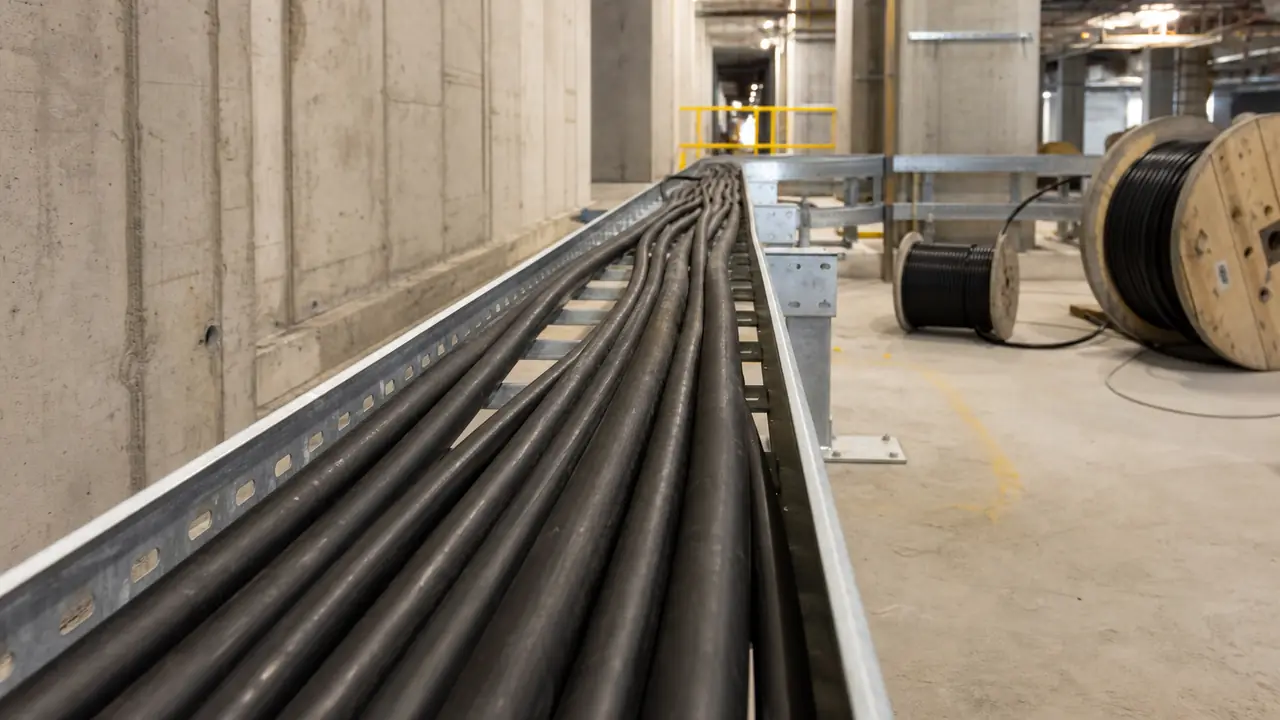
The cable schedule tells the desk how long each run is. The drum plan turns that into drums: each drum carries one or more full runs with an allowance for termination, so that no joint is needed where the specification does not allow one. Length per drum is limited by drum capacity, weight and the site's handling equipment; the drum type (wooden, steel-wood or steel) follows the weight and the destination. Wooden drums typically take 2-4 weeks to make, so the plan is fixed before production. The packaging and drums page explains drum labels, lagging and end caps.
Common risks across all project types
Three risks repeat across every application. Undersized conductors: regulators have warned about armoured cable whose effective cross-section was up to two sizes below the marking, so the desk compares conductor DC resistance per drum with IEC 60228. Wrong fire class: in the EU the CPR class must be declared on the DoP for the exact construction, and it describes reaction to fire only, not circuit integrity. Certificates that do not cover the product: a listing or approval is held by the partner plant for a specific construction and is checked in the certifier's public database per order.
MOQ and lead time follow the typical ranges on MOQ and lead time and are confirmed in writing for each order. When the mix is clear, send a brief and the desk returns matched plants, reference constructions and a draft drum plan.