
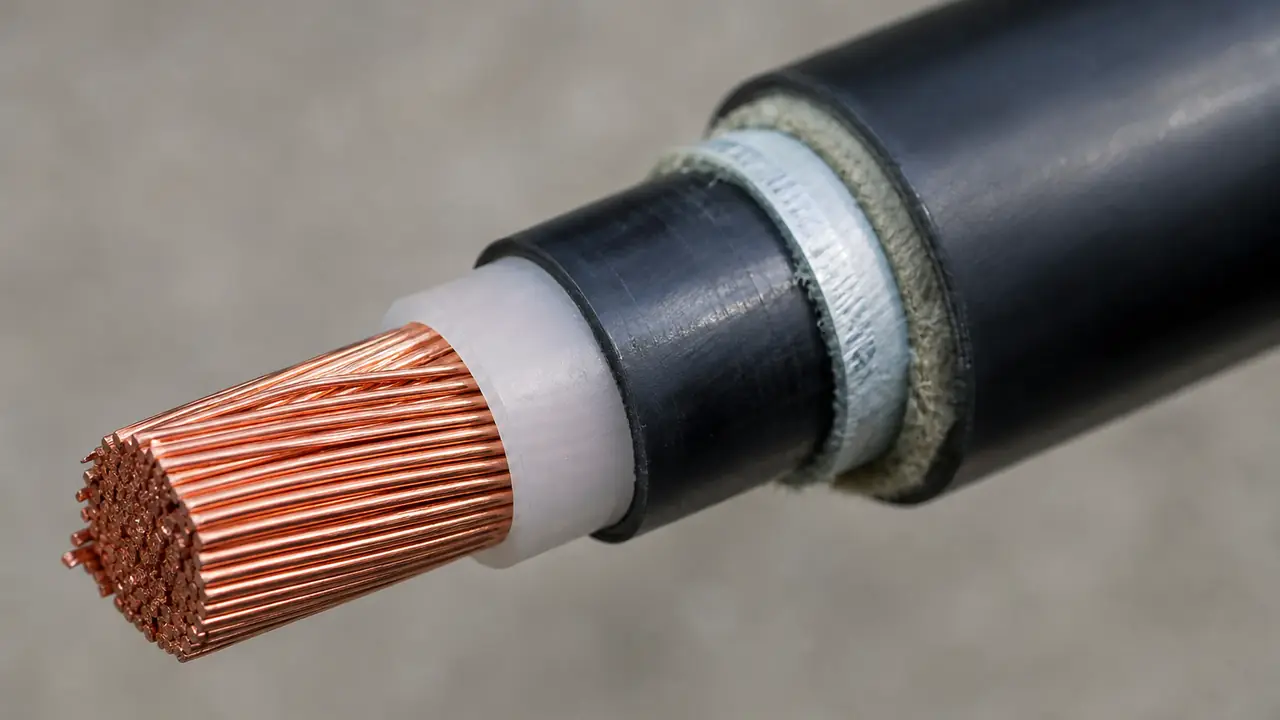


Why a buyer needs the engineering view
Two quotes for the same headline cable, say 4x25 mm2 power cable or a 24-core outdoor fibre cable, can describe very different products. One may use a Class 2 annealed copper conductor that meets the IEC 60228 resistance limit and 0.9 mm of XLPE; the other may run thin on copper or insulation and still print the same size on the sheath. The price gap is real, but so is the gap in what arrives on site. Reading a construction layer by layer is the most reliable way to compare offers, and it is how the desk writes every spec sheet before a partner plant is booked.
The pages in this section are written for brand owners, distributors, contractors and sourcing agents rather than cable designers. They explain what each layer does, which standard sets it, how the plant proves it on each drum, and which choices change cost, weight and lead time. Figures come from reference constructions in a partner plant catalogue or public datasheets and from the standards named; they are not measured values for your order.
The layers, from the inside out
A power cable is built from a conductor, insulation, core identification, fillers and binder tape, optional screens or armour, and an outer sheath, finished with print, metre marks and a drum. A fibre cable replaces the conductor with glass fibres in tight buffers or loose tubes, adds strength members and water blocking, and finishes with a jacket. The table maps each topic to its page.
| Topic | What it decides | Key references |
|---|---|---|
| Conductor materials | Copper or aluminium, solid or stranded, plain or tinned | IEC 60228 Classes 1, 2, 5 and 6 |
| Insulation and sheaths | Temperature rating, thickness, LSZH or PVC | IEC 60502-1/-2, IEC 61034, IEC 60754 |
| Armour and screens | Mechanical protection, earthing path, interference | IEC 60502-1, BS 5467, BS 6724 |
| Fire performance classes | Reaction to fire and circuit integrity | EN 50575, IEC 60332, IEC 60331, BS 8519 |
| Fibre types and standards | Single-mode or multimode, bend class, cable build | ITU-T G.652.D / G.657, TIA-568, TIA-598 |
| Marking and identification | Sheath print, core colours, drum tags | IEC colour convention, TIS 11, CPR label |
Which choices move price, weight and lead time
Copper and aluminium account for roughly 80 percent of the cost of a wire or cable product, according to listed cable makers' filings, and quotes are usually built as metal price plus a processing fee. That is why conductor material and size dominate price, and why quote validity is short. Weight follows the same logic: the reference 0.6/1 kV Cu/XLPE/PVC 4x25 mm2 cable weighs about 1,292 kg/km, the 4x35 mm2 steel tape armoured version about 2,067 kg/km, and the 4x95 mm2 aluminium cable about 1,907 kg/km, per the partner plant catalogue.
- Conductor: metal, class and size set most of the price and the drum weight.
- Insulation and sheath: XLPE against PVC, LSZH against PVC, and UV or oil grades change compound cost and sometimes the plant.
- Armour and screens: add process steps, weight and diameter, which changes drum size and freight.
- Fire performance: a declared CPR class or a circuit integrity report narrows the plants that can supply.
- Marking and packing: custom print and drum plans add little cost but must be fixed before production.
How each layer is proved
Routine tests are run on every drum: conductor DC resistance at 20 C, a spark test on insulation, a voltage test, dimension checks on insulation thickness and overall diameter, and a check of the sheath print and metre marks. Medium voltage cable adds a partial discharge test to IEC 60885-3. Sample and type tests, such as flame tests, smoke and acid gas tests or thermal ageing, are carried by test reports for the construction. Fibre cable is checked with OTDR traces and, for patch cords, insertion and return loss. The desk collects these records per drum and checks them against the spec sheet before loading.
How to use these pages on a real order
- Pick the construction from the product line pages, such as LV power cables or outdoor fibre, and note the standard your market names.
- Use the engineering pages to decide each layer: conductor class, insulation, sheath, armour, fire class and marking.
- Send the construction, sizes, metres and port through the quote form; the desk returns a spec sheet that fixes every layer.
- Agree the drum plan and the test records you need; MOQ and timing are set out on MOQ and lead time and confirmed in writing.