
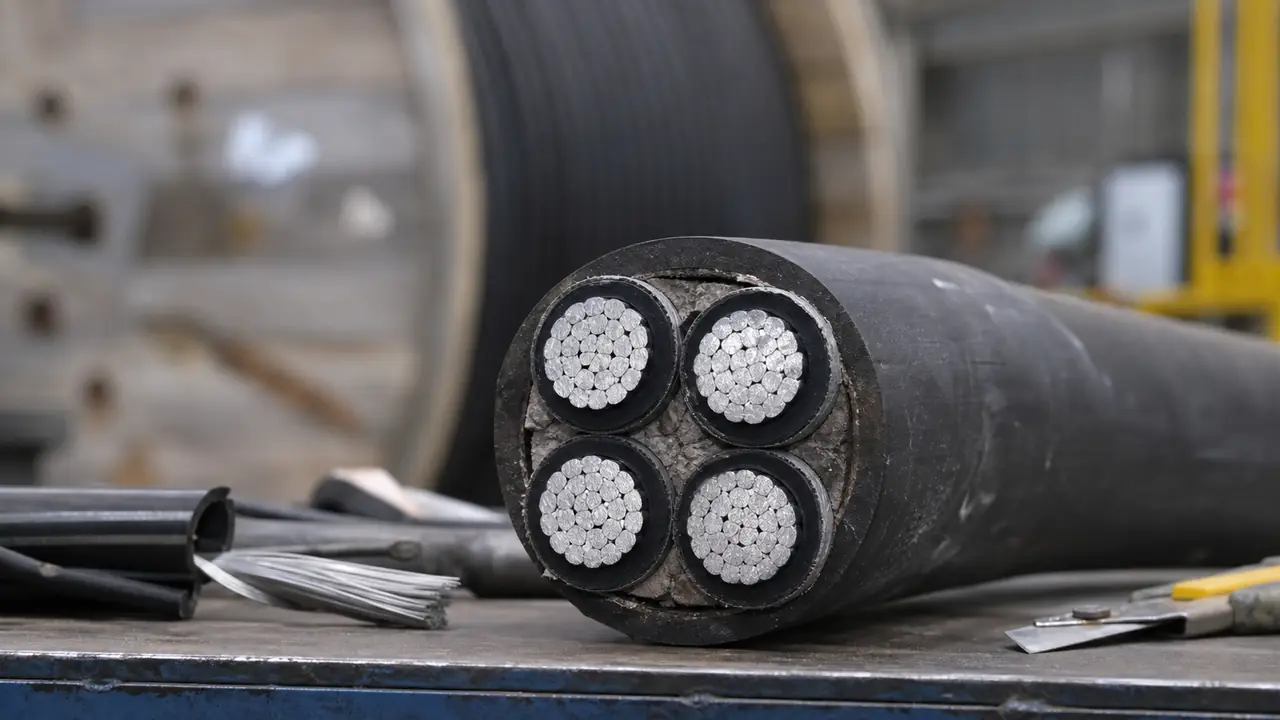
What this cable is
An aluminium power cable uses stranded aluminium conductors instead of copper in an otherwise familiar 0.6/1 kV XLPE construction. The reference on this page is the four-core 95 mm2 Al/XLPE/PVC cable from a partner plant catalogue (YJLV in Chinese designation): round stranded aluminium conductors, 1.1 mm of XLPE insulation, fillers and binder tape, and a 2.1 mm PVC sheath. It is about 40 mm overall and weighs about 1,907 kg per kilometre. The conductor resistance limit is 0.320 ohm/km at 20 C, the IEC 60228 Class 2 figure for 95 mm2 aluminium.
Aluminium cable is most common on large feeders, distribution networks, solar farm AC collection and building risers, where conductor sizes are big and weight and metal cost add up quickly. Copper and aluminium together are around 80% of a cable's cost according to listed company filings, so the metal choice usually moves a quote more than any other line item.
Copper vs aluminium: equal resistance means a bigger size
Aluminium conducts less well than copper, so a circuit that needs a given resistance needs a larger aluminium cross-section. The IEC 60228 Class 2 limits show the relationship clearly.
| Size | Copper | Aluminium | Nearest copper by resistance |
|---|---|---|---|
| 16 mm2 | 1.15 | 1.91 | 10 mm2 copper (1.83) |
| 25 mm2 | 0.727 | 1.20 | 16 mm2 copper (1.15) |
| 35 mm2 | 0.524 | 0.868 | 25 mm2 copper (0.727) is lower |
| 50 mm2 | 0.387 | 0.641 | 35 mm2 copper (0.524) is lower |
| 95 mm2 | 0.193 | 0.320 | between 50 (0.387) and 70 mm2 (0.268) copper |
| 120 mm2 | 0.153 | 0.253 | 70 mm2 copper (0.268) |
This is a resistance comparison only. The actual size for each circuit also depends on installation method, grouping, ambient temperature, voltage drop and short-circuit level, set by your engineer under IEC 60364-5-52, BS 7671 or NEC as applicable. We do not publish current ratings; see the cable sizing guide for the inputs.
Where aluminium fits, and where it does not
- Good fit: large feeders and sub-mains, utility and solar farm AC circuits, long runs where weight affects handling and supports.
- Use with care: board terminations need lugs and connectors rated for aluminium, the right contact compound and torque procedure, and installers trained for them.
- Usually not offered: small sizes. The catalogue range starts at 10 mm2, and wiring rules such as NEC 310.3 set a minimum of 12 AWG for aluminium; final circuits and flexible cable stay copper.
Copper-clad aluminium is a different product and is not a substitute where copper is specified; in category network cable it is a counterfeit. See CCA vs copper.
What you can change
As with copper cable, the conductor class and insulation thickness follow the standard. Sheath material (PVC or LSZH with fire tests per report), core identification, sheath print and drum type change routinely. For buried routes the catalogue offers a steel tape armoured version, the YJLV22 type; see armoured cables. Sector-shaped conductors on larger multicore sizes reduce diameter and are confirmed on the plant datasheet.
How the desk runs an aluminium cable order
Most aluminium enquiries arrive as a BOQ that mixes copper and aluminium sizes, sometimes with a request to convert copper sizes to aluminium. The desk does not do that conversion: it returns the resistance comparison above and asks your engineer to confirm each aluminium size, so that the cable on site matches the design calculation. Once sizes are fixed, the spec sheet records the conductor shape and strand count, insulation and sheath thickness, core identification, sheath print and the drum plan. Partner plants in Yixing and Ningjin make both copper and aluminium LV cable, which lets one order cover both metals with the same test record format. Quotes follow the usual metal price plus processing fee model and are valid for a short period, stated on the quote, because aluminium and copper prices move daily.
Checks, packing and lead time
Resistance per drum is the key record, because an undersized aluminium conductor looks the same as a correct one. The desk asks for conductor DC resistance at 20 C on each drum against the IEC 60228 aluminium limits, plus insulation thickness and outer diameter on samples; see testing and inspection. Aluminium cable ships on wooden or steel-wood drums; as a reference, 500 m of the 4x95 mm2 cable weighs roughly 954 kg net before the drum. Plant listings commonly show a minimum of around 500 m per size. Lead time depends on metal booking, the slot and routine testing, and is confirmed in writing for each order; see MOQ and lead time or send your BOQ through the quote form.