
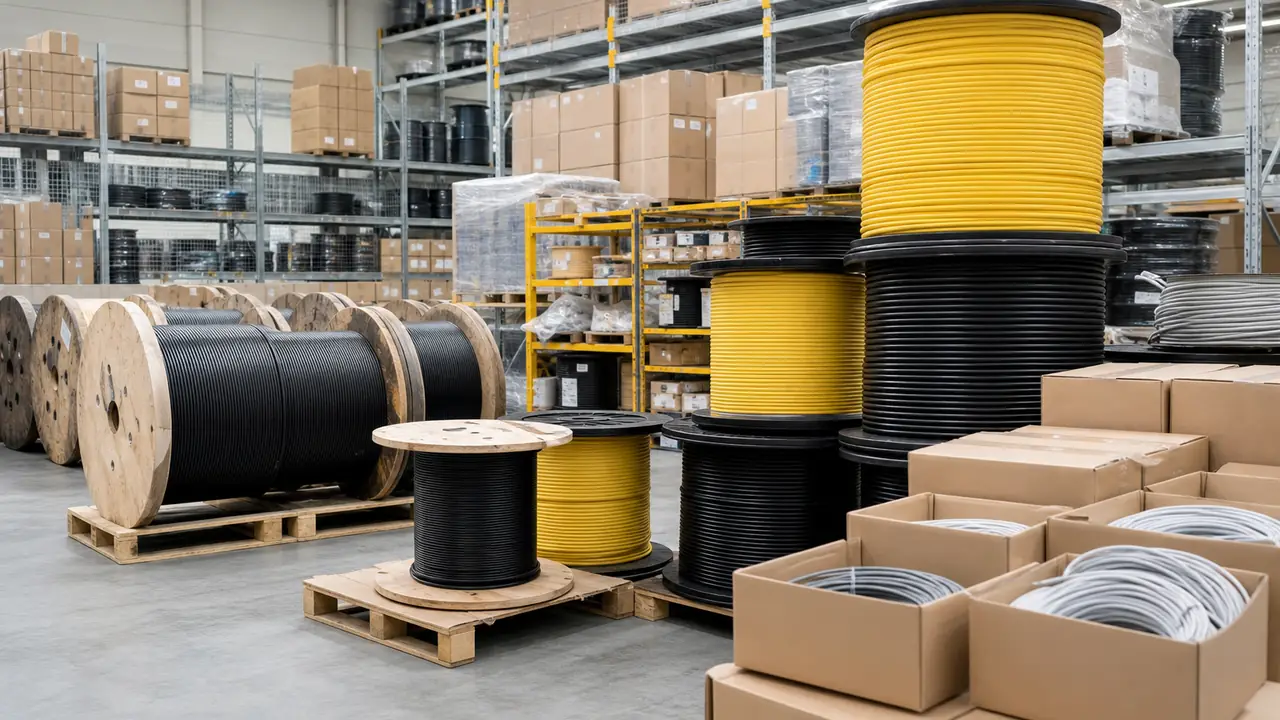
Six lines, one question: where does the signal run?
Fibre and data cables are chosen less by size than by route. The same G.652.D fibre can sit inside a 6 mm indoor distribution cable, a steel-taped duct cable or a self-supporting aerial cable; what changes is the protection around it. Data cable over copper is the opposite: the conductor is fixed by the category standard, and the choice is jacket rating, shielding and packing. This page sorts the six lines the desk sources and links to the detail page for each, where the layer table, reference construction and ordering notes sit.
China is the largest exporter in both halves of this family. In 2023 its fibre optic cable exports under HS 8544.70 were about USD 2.34 billion, around 25% of the world total, and optical fibre under HS 9001.10 was about USD 689.5 million (TrendEconomy / UN Comtrade). Wuhan's Optics Valley, from preform to cable, is described by the city government as holding more than a quarter of the international fibre and cable market (2021/2022); Wujiang Qidu is a national Torch Programme base for optical and electrical cable; Dongguan Humen, with about 200 sizeable enterprises and about 22 billion yuan of output (21st Century Business Herald, 2022), makes network and consumer cable.
Single-mode or multimode
Start with the fibre, because it fixes the transceivers and the distances. Single-mode fibre to ITU-T G.652.D is the default for access, metro and long runs; its bend-insensitive cousin G.657 (A1 at 10 mm minimum bend radius, A2 at 7.5 mm) is splice-compatible with G.652.D and preferred for FTTH and tight enclosures. Multimode 50/125 um fibre to OM3, OM4 or OM5 is used for short links inside buildings and data centres with lower-cost 850 nm optics. OM4 is commonly quoted at 400 m for 10 Gb/s (IEEE 10GBASE-SR). The optical fibre page covers geometry, bandwidth and colour codes.
Indoor, outdoor, aerial or drop
The cable around the fibre follows the environment. Indoor cable uses tight buffers and a flame-retardant or LSZH jacket because it lives in risers, trays and racks where fire behaviour is regulated: in the EU it falls under EN 50575 with a CPR class declared on the DoP, and in the US under NEC Article 770 ratings such as OFNR and OFNP. Outdoor cable uses gel-filled loose tubes, water blocking and a PE sheath because it lives in ducts and moisture. Aerial cable must carry its own weight across a span, and drop cable has to bend into a home and be terminated by an installer in minutes.
| Line | Reference construction | Typical route | Key spec to fix |
|---|---|---|---|
| Optical fibre | G.652.D, 125 um cladding, 242 um coating | Inside every cable below | Fibre type, coating size, test data |
| Indoor fibre cables | 12-core tight-buffered, OD approx. 6.0-6.3 mm | Risers, racks, office floors | Jacket and CPR or NEC rating |
| Outdoor fibre cables | GYTS 24-core loose tube, OD approx. 10 mm | Ducts, aerial on messenger, burial when armoured | Tube count, tape type, drum length |
| ADSS aerial cables | 24-core ADSS, 100 m span class | Power poles and towers | Span, weather loading, sheath type |
| FTTH drop and patch cords | GJXFH flat drop 2.0x3.0 mm, G.657 | Last metres into the home | Fibre grade, strength member, connector grade |
| LAN and coax cables | Cat6 U/UTP 23 AWG, 305 m box; RG6 | Buildings, CCTV, broadband | Solid copper, jacket rating, packing |
LAN and coax: copper that must be honest
Category network cable requires solid copper conductors. Copper-clad aluminium sold as Cat6 is not a compliant category cable, runs hotter under PoE and is the most common fraud in marketplace channels. The desk specifies the conductor diameter (0.555-0.58 mm for the 23 AWG reference), checks it on samples and asks for link test reports. US jacket ratings run CMP above CMR above CMG/CM above CMX. RG6 coax is sourced with the inner conductor material stated on the datasheet, copper-clad steel or bare copper, so the buyer knows which one is on the reel.
What decides the price, and what does not
Fibre cable cost is driven by core count, fibre grade, tube and armour construction and drum length; copper data cable by copper weight, jacket compound and packing. Attenuation is not a negotiating lever: cabled single-mode fibre is held to the G.652 table limits of 0.4 dB/km at 1310 nm and 0.3 dB/km at 1550 nm, and the product values are per datasheet with OTDR records per drum. A quote that is cheap because of fewer tubes, thinner sheath or CCA conductors is not a saving. The fibre optic buying guide lists the checks.
How to start an order
- Send the route, core count, fibre type, jacket or rating and metres through the quote form.
- The desk shortlists partner plants in the right cluster and confirms construction against their datasheets.
- Samples or a trial drum are checked; the spec sheet fixes print, drum length and test records.
- MOQ and lead time are confirmed in writing for each order; see MOQ and lead time.