
What this line covers
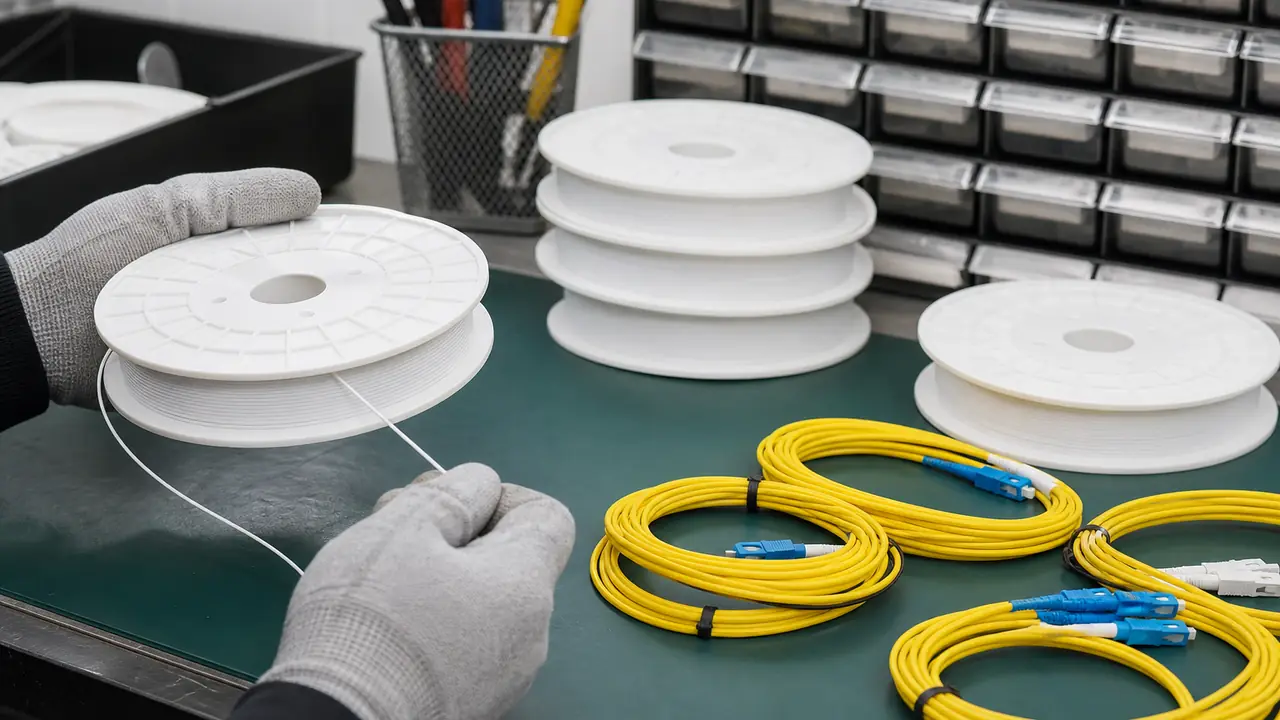
FTTH networks end in two products that are usually bought together. The first is drop cable, which runs from a distribution box or splitter into the building and to the wall outlet. The second is the patch cord, a short length of cable with factory-fitted connectors at each end that links the outlet, the terminal and the panels. The reference drop cable on this page is the flat, or butterfly, construction known in Chinese designation as GJXFH, taken from public datasheets: one or two G.657 fibres in the centre, two parallel strength members, and an LSZH jacket of about 2.0 x 3.0 mm with a tear notch on each side. Reference weight is about 7.5-10.5 kg per kilometre and the usual reel is 1 km.
The patch cords are simplex SC or LC cords on 2.0 mm or 3.0 mm cord: a 900 um tight-buffered fibre, a layer of aramid yarn and a PVC or LSZH jacket, with the connector polish and loss grade stated on the label.
Drop cable choices
Three choices define a drop cable order. The fibre is G.657.A1 or A2: both are compatible with G.652.D, but A2 allows a minimum bend radius of 7.5 mm against 10 mm for A1, which matters around wall corners and in tight trunking, so A2 is the common choice for drops. The strength members are FRP rods, which keep the cable non-conductive and light for indoor runs, or steel wires, which suit short outdoor entries and wall-hung sections. For aerial drops, a self-supporting version with an added messenger is a separate construction. The jacket is LSZH for indoor use, white or black as the operator specifies.
| Construction | Typical build | Where it is used |
|---|---|---|
| Flat drop, FRP members | 2.0x3.0 mm, 1-2 G.657 fibres, LSZH | Indoor runs from riser or box to outlet |
| Flat drop, steel wire members | 2.0x3.0 mm, 1-2 G.657 fibres, LSZH or PVC | Short outdoor entries, wall-fixed sections |
| SC simplex cord | 2.0 or 3.0 mm, UPC or APC | Outlets, ONT and splitter connections |
| LC simplex or duplex cord | 2.0 mm common | High-density panels and equipment ports |
Tensile load is where datasheets disagree most: published long and short term ratings for FRP-type flat drop differ by about 2.5 times between makers. The desk takes the figure from the datasheet of the plant actually quoting, and installers work to that value. The FTTH drop cable types article compares flat, round and self-supporting builds.
Patch cord grades under IEC 61753-1
A patch cord is judged by insertion loss (IL) and return loss (RL) at its connectors. IEC 61753-1 sets performance grades so that buyers can specify a level instead of a brand. For single-mode connections, Grade B allows a mean IL of 0.12 dB or less, with 97% of connections at 0.25 dB or less; Grade C allows a mean of 0.25 dB or less. For return loss, Grade 1 is 60 dB or more and is reached with APC (angled) polish; Grade 2 is 45 dB or more, typical of UPC polish.
APC connectors, usually green, are used on PON and CATV links; UPC connectors, usually blue, are common on Ethernet equipment. The two must not be mated with each other. A 2.0 mm cord packs more densely on a patch panel, while 3.0 mm cord tolerates more handling at equipment. See UPC vs APC polish and SC vs LC connectors.
Branding, reels and labels
Drop cable can carry your print and metre marks on the jacket. Patch cords are usually bagged one per bag with a test label, and the bag, label and carton can be printed for your brand; for marketplace or retail sale, the carton artwork and barcode are fixed on the spec sheet. Drop cable ships on 1 km reels in cartons. Fibre attenuation records come with each reel and IL and RL values with each cord.
How the desk runs an FTTH order
- You send the drop construction, fibre type, metres, cord connectors, polish, lengths and grades through the quote form.
- The desk shortlists partner plants in the fibre clusters, often in Wuhan, that make both drop cable and terminated cords, and checks their test benches and records.
- The spec sheet fixes the fibre, strength members, jacket, connector types, grades and labels; a few sample cords are tested before the main run.
- Reels and cord cartons are inspected for count, labels and records before loading. Lead time is confirmed in writing for each order; see MOQ and lead time and the telecom and FTTH page.