
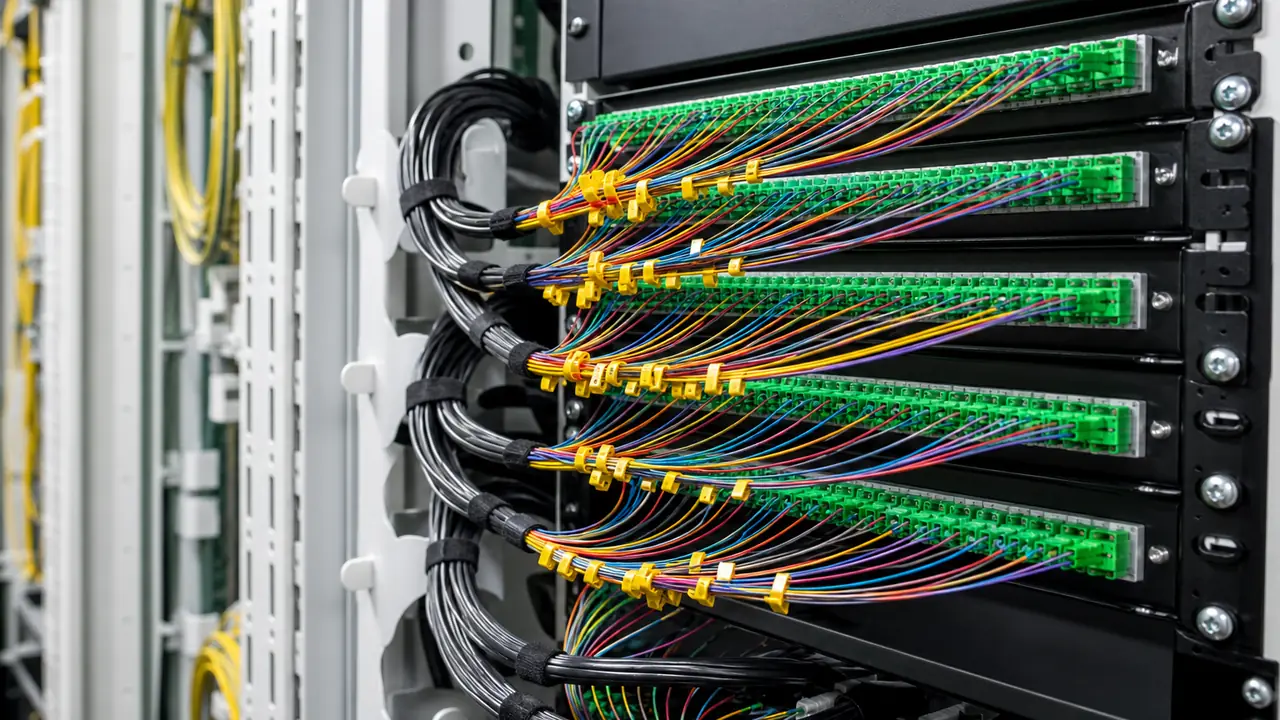
What this cable is
Indoor tight-buffered cable carries fibre inside buildings: from the entrance room up the riser, along trays to floor distributors, and between racks in comms rooms and data halls. Each fibre is coated directly with a 0.9 mm buffer, so it can be stripped and terminated straight onto a connector or pigtail without a fan-out kit. The reference construction from public datasheets is the 12-core distribution cable of the GJFJV (PVC) and GJFJH (LSZH) types: twelve 0.9 mm tight-buffered fibres, aramid yarn for tensile strength and an outer jacket, about 6.0-6.3 mm overall and about 33-41 kg per kilometre. Weight differs by roughly a quarter between makers at the same core count, so freight is estimated from the chosen datasheet.
Because the cable lives where people are, the jacket matters as much as the fibre. In the EU, cable permanently installed in buildings falls under EN 50575, and the CPR class is declared on the DoP with the CE mark on the label; order by class rather than just 'LSZH'. In the US, NEC Article 770 ratings apply, with OFNR for risers and OFNP for plenum spaces, and US projects usually require listed products to satisfy the AHJ. Any listing belongs to the partner plant and that construction, checked in the certifier's public database per order.
Constructions and sizes
| Construction | Typical counts | Where it is used |
|---|---|---|
| Simplex cord cable, 2.0 or 3.0 mm | 1 fibre | Patch cords and pigtails |
| Duplex cord cable | 2 fibres | Rack-to-rack and equipment cords |
| Distribution cable, 0.9 mm buffers | 2-24 cores | Riser and horizontal runs, direct termination |
| Distribution cable with FRP central member | Higher counts up to 144 cores | Backbones between floors and halls |
| Breakout cable, sub-units | Per datasheet | Runs where each fibre needs its own jacket |
Above 24 cores the outer diameter steps up noticeably, so check tray and duct fill against the datasheet before fixing the count. Higher counts usually add an FRP central member; whether a ripcord is fitted varies by model and is confirmed on the datasheet. The fibre cable core counts article covers planning for spare fibres.
Fibre choice inside the cable
Indoor cable is built with single-mode or multimode fibre. G.652.D suits backbones that will meet outside plant; G.657.A1 or A2 tolerates tighter routing in cabinets; OM3 or OM4 multimode serves short data centre links with 850 nm optics. Jacket colour commonly signals the fibre type, for example yellow for single-mode and aqua for OM3 or OM4, but this is a convention that the spec sheet fixes rather than assumes. Buffered fibres follow the TIA-598 colour order. For link budgets, older TIA-568 planning values of 1.0 dB/km for indoor single-mode and 3.5 dB/km at 850 nm for multimode are a fallback; use the cable maker's specification where available. See optical fibre for the grades.
What you can change
- Jacket: LSZH or PVC, colour and CPR class; fire behaviour is stated per test report and the class declared on the DoP.
- Fibre mix: grade and count per cable, including mixed single-mode and multimode on request.
- Marking: your brand, fibre type, count, rating and metre marks on the jacket; see cable marking and identification.
- Drum length: 1 km and 2 km are common; other lengths on the drum plan.
Packing, MOQ and lead time
Indoor distribution and cord cable ships on wooden drums, with 1 km and 2 km common, both ends sealed and the inner end left accessible for testing. MOQ is set by drum length, core count and jacket compound, and lead time depends on the fibre supply and the buffering and jacketing slot; both are confirmed in writing for each order. See MOQ and lead time.
For projects that pull many short runs, the drum plan can split the order into lengths that match the riser and floor schedule, so installers cut less waste and each drum label ties to a zone on the drawings. Brand owners selling boxed cord cable or pre-cut lengths can fix carton size, label text and barcode on the same spec sheet; the desk checks them at pre-shipment inspection together with jacket print and diameter.
How the desk runs an indoor fibre order
- Send core count, fibre grade, jacket rating, colour and metres through the quote form.
- The desk shortlists partner plants with the rating you need and checks their reports and DoP.
- The spec sheet fixes buffers, jacket, print and drum plan; a sample length is checked first.
- Per-fibre test records are collected and drums inspected for length, print and diameter before loading.