
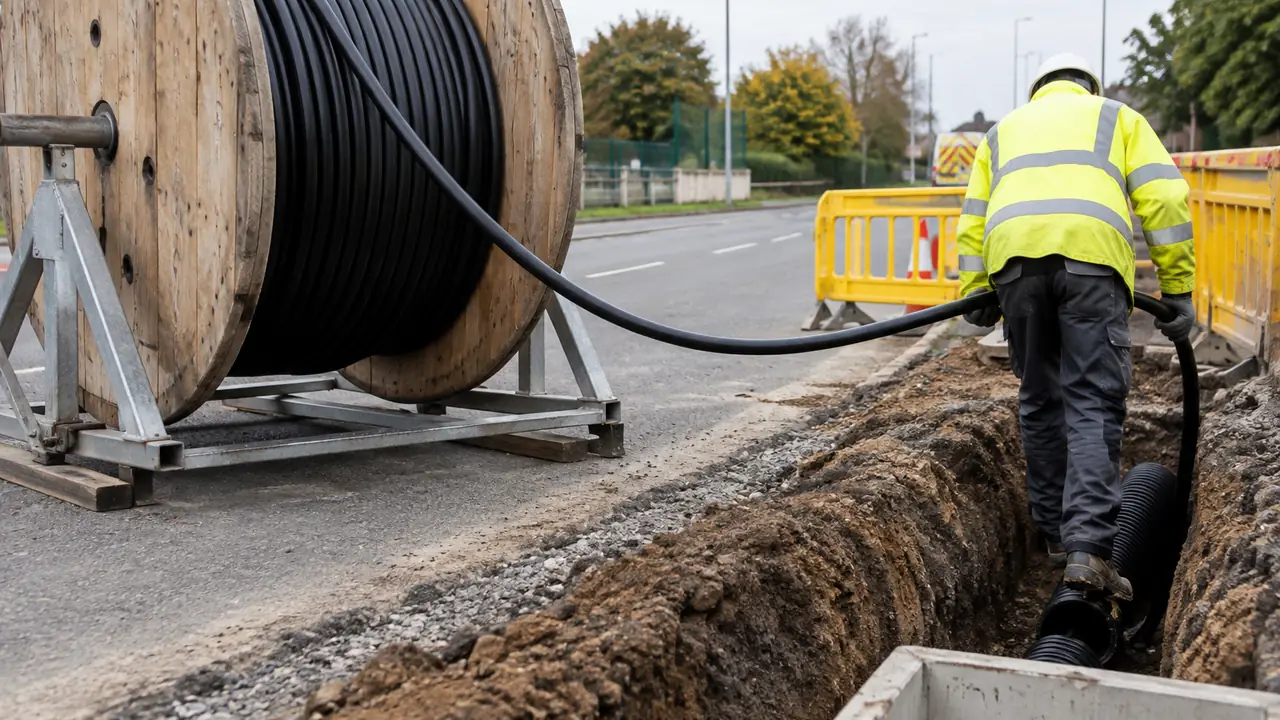
What this cable is
Outdoor loose tube cable is the standard cable for telecom ducts and outside plant. The fibres float loosely in gel-filled tubes, so the glass is isolated from the strain and temperature movement of the sheath. The reference construction from public datasheets is the GYTS 24-core cable: a central steel wire, gel-filled PBT loose tubes and filler rods stranded around it, a water-blocking layer, a corrugated plastic-coated steel tape (PSP) and a black PE sheath, about 9.7-10.5 mm overall. Weight for the same 24-core design runs from about 76 to 116 kg per kilometre between makers, a spread of roughly 50%, so the figure is always taken per datasheet. GYTA is the same build with an aluminium-polyethylene laminated tape (APL) in place of steel.
China produced 323 million fibre-km of optical cable in 2023 and 269 million in 2024 (National Bureau of Statistics), and exported 379,100 tonnes worth 16.83 billion yuan in 2024 (General Administration of Customs, via C114, 2025-02). The desk sources outdoor cable mainly from partner plants in Wuhan and in Wujiang Qidu, a national Torch Programme base for optical and electrical cable.
Choosing the construction for the route
| Construction | Tape and member | Typical route | Note |
|---|---|---|---|
| GYTS | PSP steel tape, steel central wire | Ducts where rodents are a risk | Reference construction on this page |
| GYTA | APL aluminium tape, steel central wire | Ducts, aerial lashed to a messenger | Lighter, moisture barrier |
| GYTA53 / GYTS53 | Second sheath and steel tape armour | Direct burial | Do not bury plain GYTS |
| GYFTY | Non-metallic, FRP central member | Near power lines, lightning-prone areas | No earthing of metal parts needed |
| Self-supporting aerial | All-dielectric | Pole lines without messenger | See ADSS aerial cables |
Metallic members and tapes must be earthed at joints and terminations. Where cable runs alongside power circuits, a non-metallic design avoids that work. The armoured fibre cable article covers rodent, crush and burial protection in more detail.
Tubes, counts and the splice closure
Two plants can both quote '24-core GYTS' and build it differently: two tubes of 12 fibres, or four tubes of 6 with fillers. That changes the splice tray layout in every closure on the network, so the spec sheet always states tubes times fibres per tube, the tube colour order and the fibre colour order to TIA-598. The category runs from 2 to 288 cores; above the reference size the diameter and weight rise and the drum plan changes with them. See fibre cable core counts for planning spare capacity.
Fibre and attenuation
Outdoor cable normally carries G.652.D single-mode fibre, with G.657.A1 used by some operators for compatibility with drop cables. Cabled fibre is held to the G.652 table limits of 0.4 dB/km at 1310 nm and 0.3 dB/km at 1550 nm, and the product values are per datasheet. Older TIA-568 planning values use 0.5 dB/km for outdoor single-mode, plus 0.3 dB per splice and 0.75 dB per connector pair; use the cable maker's specification where available. Each fibre on each drum gets an OTDR trace before loading, and the records go with the shipping documents; see fibre OTDR test reports.
What you can change
- Tape and member: PSP steel or APL aluminium tape; steel wire or FRP central member.
- Sheath: MDPE or HDPE, single or double, with sheath print in your brand, count, type and metre marks.
- Fibre mix: G.652.D or G.657.A1 by tube, fixed on the spec sheet.
- Drum length: 2 km is the most common, 4 km is standard for long routes, and other lengths can be set per order.
Packing, MOQ and lead time
Outdoor cable ships on wooden or steel-wood drums with both ends capped and the inner end left accessible for testing. MOQ is usually expressed in full drums, and lead time depends on fibre supply, tube and sheathing slots and testing; both are confirmed in writing for each order. See MOQ and lead time and packaging and drums.
Operators building out a network in phases can call off drums against one fixed specification, so cable from the second and third shipments matches the first in tube layout, colour order and sheath print. The desk keeps the approved spec sheet and the sample test records on file and checks each later drum against them.
How the desk runs an outdoor fibre order
- Send the route, core count, tubes, tape type and kilometres through the quote form.
- The desk shortlists partner plants and checks their datasheets against your network specification.
- The spec sheet fixes the build, print and drum plan; a trial drum or sample length is checked first.
- OTDR records are collected per drum and drums inspected for length, print and end caps before loading.