
What this line covers
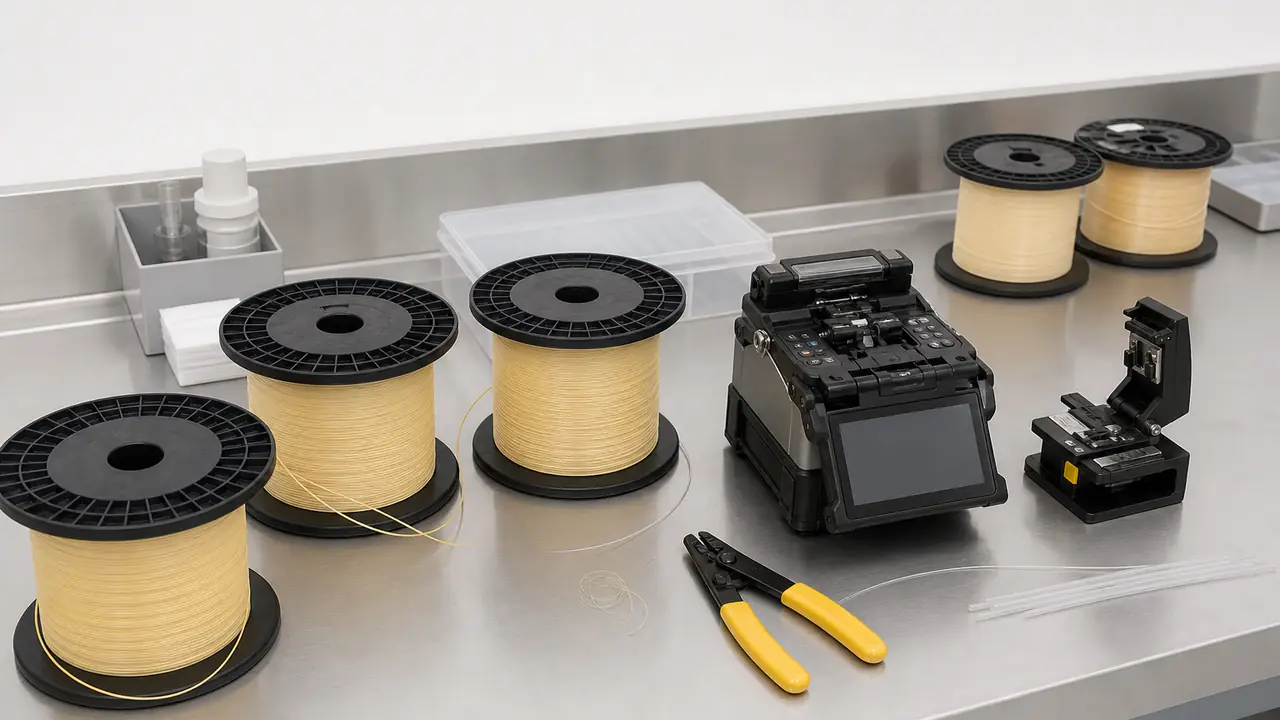
Optical fibre is the drawn glass strand with its coatings, before it is buffered, tubed or cabled. Buyers here are usually cable plants, assembly shops making patch cords and pigtails, or brand owners who want to fix the fibre grade inside a cable they private label. The reference construction from public datasheets is single-mode fibre to ITU-T G.652.D: a germanium-doped silica core inside a 125.0 +/- 0.7 um silica cladding (a typical manufacturer tolerance), covered by a soft primary and a hard secondary UV acrylate coating to 242 +/- 7 um, about 250 um once coloured. A reduced 200 um coating is offered for high-count and micro cables.
China is the largest exporter of optical fibre: about USD 689.5 million under HS 9001.10 in 2023, 25.6% of the world total (TrendEconomy / UN Comtrade), and 27,300 tonnes in 2024 (General Administration of Customs, via C114, 2025-02). Most of the preform-to-fibre chain the desk works with sits in Wuhan's Optics Valley.
Single-mode grades: G.652.D and G.657
G.652.D is the standard single-mode fibre for access, metro and long-haul cable. G.657 is the bend-insensitive family: G.657.A1 has a minimum bend radius of 10 mm, A2 and B2 7.5 mm, and B3 5 mm. The A category is compatible with G.652.D, so A1 or A2 fibre can be spliced into a G.652.D network; that is why FTTH drop cables and enclosures use G.657.A1 or A2 while feeder cables stay on G.652.D. Mode field diameter at 1310 nm differs between fibre makers, typically 8.6-9.2 um, and is taken from the datasheet rather than treated as a standard value. When fibres with different mode field diameters are spliced, a one-way OTDR trace can show an apparent gain or extra loss at the joint, so acceptance tests average both directions.
| Grade | Core / cladding | Key figure | Typical use |
|---|---|---|---|
| G.652.D single-mode | Single-mode / 125 um | Cabled limit 0.4 dB/km at 1310 nm, 0.3 dB/km at 1550 nm | Feeder, distribution, long runs |
| G.657.A1 | Single-mode / 125 um | Minimum bend radius 10 mm | FTTH distribution, enclosures |
| G.657.A2 / B2 | Single-mode / 125 um | Minimum bend radius 7.5 mm | Drop cable, indoor routing |
| OM3 | 50 / 125 um | EMB at least 2,000 MHz.km at 850 nm | Short data centre links |
| OM4 | 50 / 125 um | EMB at least 4,700 MHz.km at 850 nm | Data centre, commonly quoted 400 m at 10 Gb/s |
| OM5 | 50 / 125 um | Also 2,470 MHz.km at 953 nm | Short-wave multiplexing links |
Multimode grades: OM3, OM4 and OM5
Multimode fibre has a 50 um core in the same 125 um cladding. The grades differ in effective modal bandwidth at 850 nm: at least 2,000 MHz.km for OM3 and 4,700 MHz.km for OM4, with OM5 also specified at 953 nm (2,470 MHz.km) for short-wave multiplexing. OM4 is commonly quoted at 400 m for 10 Gb/s under IEEE 10GBASE-SR. New data centre builds usually start at OM4. OM3 and OM4 can be connected, but the link is planned at the lower grade. Multimode attenuation is taken per standard and datasheet; older TIA-568 planning values of 3.5 dB/km at 850 nm and 1.5 dB/km at 1300 nm are a conservative fallback when no maker's figure is available. See single-mode vs multimode fibre.
Attenuation: what to write on the spec sheet
Single-mode attenuation is quoted two ways and they are often mixed up. The G.652 tables give cabled fibre limits of 0.4 dB/km at 1310 nm and 0.3 dB/km at 1550 nm. Bare fibre values are tighter and differ by maker, so the spec sheet takes them from the fibre datasheet named on the order and asks for per-spool test records. Do not accept a quote that names only 'G.652.D': ask for the fibre maker's datasheet and model and the factory test report. The fibre attenuation explainer shows how splices and connectors add to a link budget.
Coatings, colours and what you can change
- Coating diameter: 242 um standard, 200 um reduced. The 200 um option packs more fibres into a tube, but strippers and fusion splicer holders must match.
- Colour code: the 12-colour TIA-598 sequence (blue, orange, green, brown, slate, white, red, black, yellow, violet, rose, aqua) is standard; ring marks or other orders follow the operator's rules. See fibre colour codes.
- Grade mix: one cable can carry G.652.D and G.657 fibres if the operator wants it; this is fixed tube by tube on the spec sheet.
How the desk runs a fibre order
- Send the grade, coating size, colour scheme and fibre-km through the quote form.
- The desk matches drawing plants in the Wuhan cluster and collects their datasheets and sample spool test sheets.
- Geometry and attenuation records are checked per spool before loading; MOQ and lead time are confirmed in writing (see MOQ and lead time).