
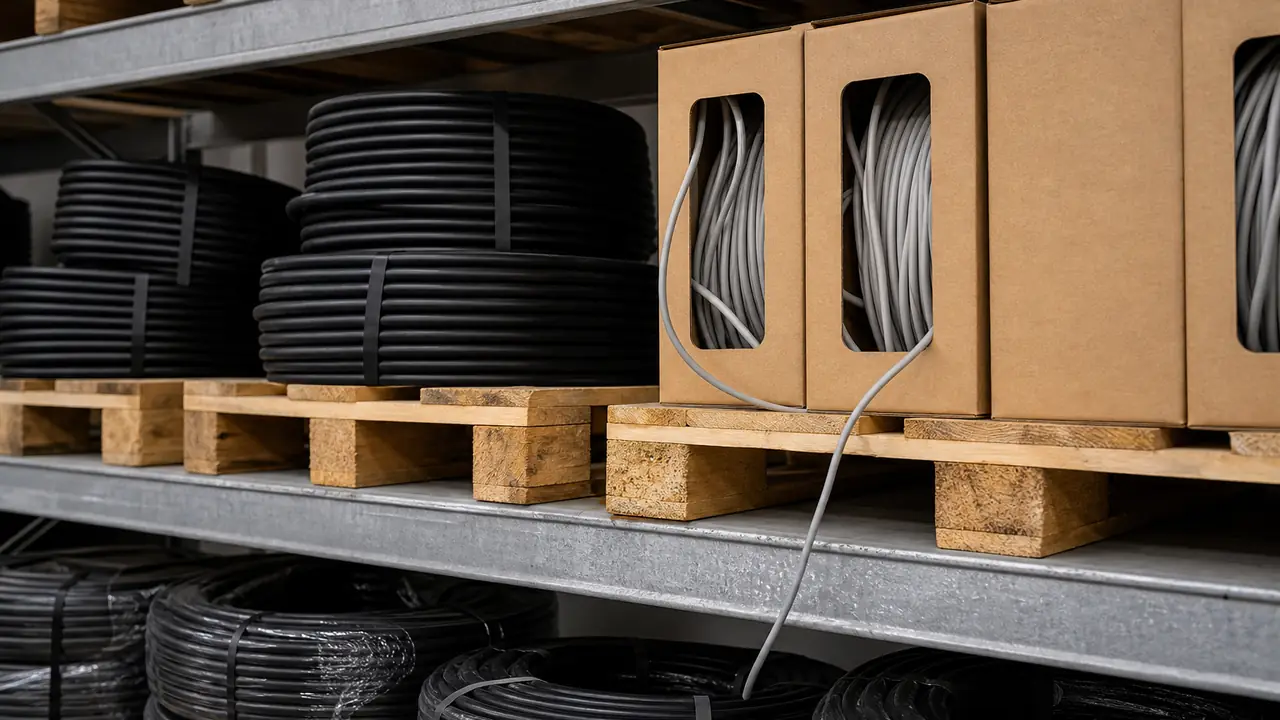
What this line covers
This line covers the two copper data cables most buyers order in volume. Cat6 U/UTP is the unshielded four-pair cable used for Ethernet in offices, homes, cameras and access points. RG6 is the 75 ohm coaxial cable used for TV, satellite and video. Both come mainly from plants in the information cable cluster around Humen in Dongguan, Guangdong, which has about 200 above-scale firms and about 22 billion yuan of annual output (21st Century Business Herald, 2022).
The reference Cat6 construction, from public datasheets, is a 23 AWG U/UTP cable: eight solid bare copper conductors of 0.555-0.58 mm with HDPE insulation, twisted into four pairs with different lay lengths, separated by a cross filler, with a ripcord under a PVC or LSZH jacket. Overall diameter is about 6.0-6.2 mm, weight about 40-43 kg per kilometre, and a 305 m box weighs about 13.5-14 kg gross. It is made to TIA-568 Category 6 and ISO/IEC 11801 Class E.
Category cable needs solid copper
Category cable requires solid copper conductors. Copper-clad aluminium (CCA) cable sold as Cat6 does not meet the category standards and is a counterfeit, however it is printed. CCA weighs about 30% less, shows aluminium colour when the conductor is scraped, and can be confirmed by XRF testing. Under PoE, an aluminium conductor also heats more than copper, which is why conductor size and material matter more as power over the cable rises; see PoE and conductor size.
A second trap is gauge. Both 23 AWG and lighter 24 AWG cables are sold as Cat6, so the RFQ must state the gauge and the conductor material. The desk weighs a box, measures the conductor and checks DC resistance against the datasheet before loading, as described in CCA vs copper conductors.
Jackets, NEC ratings and CPR classes
The jacket decides where the cable may be installed. In the US, NEC ratings rank communications cable by fire behaviour, from CMP (plenum) above CMR (riser), then CMG or CM (general), then CMX (limited use). A higher rating can replace a lower one, not the reverse. US projects usually require UL-listed (or other NRTL-listed) products to satisfy the AHJ, so the desk works from a UL listing held by the partner plant for that construction, checked in the certifier's public database per order. In the EU, cable permanently installed in buildings carries a CPR class such as Eca or Cca declared on the DoP. See NEC cable ratings.
| Item | Typical options | What to state on the RFQ |
|---|---|---|
| Cat6 conductor | Solid bare copper, 23 AWG | Gauge and material; CCA not accepted |
| Cat6 jacket | PVC (CM or CMR), plenum (CMP), LSZH, outdoor PE | NEC rating or CPR class and colour |
| RG6 centre conductor | Copper-clad steel or bare copper, 1.02 mm | Material per datasheet and use |
| RG6 shield | Foil plus aluminium or tinned copper braid | Braid material and coverage |
| RG6 jacket | PVC for indoor, PE for outdoor or burial | Indoor or outdoor route |
RG6 coax construction
The reference RG6, from public datasheets, has a 1.02 mm (18 AWG) centre conductor, a foamed PE dielectric of 4.57 mm, a bonded aluminium foil, a braid, and a jacket for an overall diameter of 6.6-6.95 mm. The centre conductor is copper-clad steel (CCS) for most CATV and satellite cable, or bare copper where the line also feeds DC power, because CCS has a much higher DC resistance; the datasheet must say which. Video and broadcast users often choose a heavier bare copper braid, which adds weight. Outdoor or buried runs need a PE jacket, not indoor PVC. See RG6 vs RG59 coax.
Boxes, branding, MOQ and lead time
Cat6 ships in 305 m (1,000 ft) pull boxes or reel-in-box cartons; RG6 ships on 305 m reels or boxes. Jacket print with your brand and metre or foot marks, box artwork and barcodes are routine for brand owners and marketplace sellers. Plant listings commonly show a Cat6 minimum of 50 to 100 boxes, with some accepting 10, and lead times of 5-25 days to about a month; your MOQ and lead time are confirmed in writing for each order. See MOQ and lead time.
How the desk runs a LAN or coax order
- You send the category, gauge, jacket rating, colours, box count, print text and port through the quote form.
- The desk shortlists partner plants in the Humen cluster, checks their test reports, their listings in public databases and their copper sourcing.
- The spec sheet fixes conductor, jacket, print, box artwork and the test report the cable must carry; a sample box is checked before the main run.
- Boxes are weighed, conductors measured and print checked before loading.