
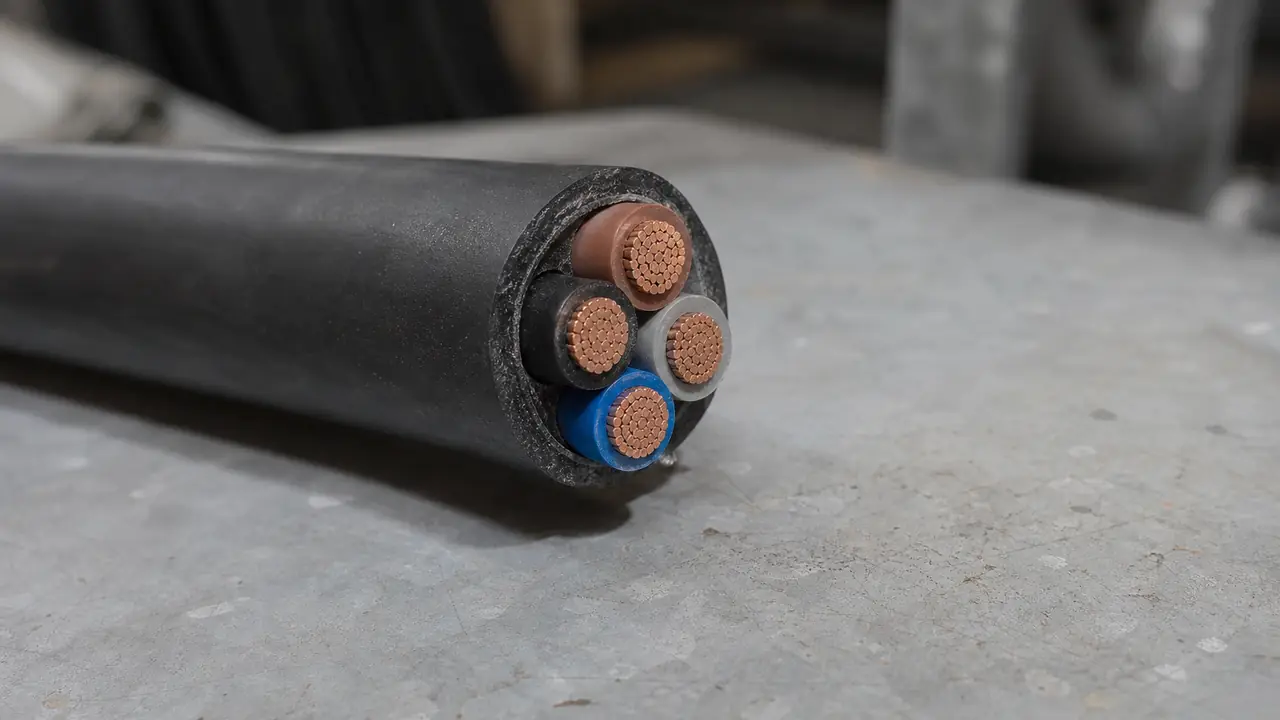
What this cable is
A 0.6/1 kV XLPE power cable carries power from a transformer or main board to distribution boards, motors, pumps and inverters. The rating means 0.6 kV between conductor and earth and 1 kV between conductors, with 1.2 kV as the highest system voltage; it is not a range from 0.6 to 1 kV. The reference construction on this page is the four-core 25 mm2 Cu/XLPE/PVC cable from a partner plant catalogue (the YJV type in Chinese designation): round stranded annealed copper conductors, 0.9 mm of XLPE insulation, polypropylene fillers and a non-woven binder tape, and a 1.8 mm PVC sheath, about 25 mm overall and about 1,292 kg per kilometre.
XLPE is chosen over PVC insulation because it runs at 90 C continuously and tolerates 250 C in a short circuit, against 70 C for PVC. For the same conductor that usually means a higher current rating, but the actual size is always set by the installation method, grouping, ambient temperature, voltage drop and fault level under your wiring rules. We do not publish current ratings; your project engineer sizes the cable, and the cable sizing guide explains the inputs.
Sizes and constructions buyers order
The plant catalogue behind this reference covers single core from 10 to 630 mm2, two to five cores from 1.5 to 400 mm2, and reduced neutral or earth versions such as 3+1, 3+2 and 4+1. The table shows how the range is usually split.
| Construction | Typical sizes | Where it is used |
|---|---|---|
| Single core Cu/XLPE/PVC | 10-630 mm2 | Large feeders, transformer tails, laid in trefoil |
| Multicore Cu/XLPE/PVC, 2-5 cores | 1.5-400 mm2 | Sub-mains, motor and pump feeds |
| Reduced neutral, 3+1 / 3+2 / 4+1 | 3x2.5+1x1.5 up to 4x400+1x185 | Distribution where the neutral or earth is smaller |
| LSZH sheath version | As above | Public buildings, tunnels; fire tests per report |
| Armoured version | See armoured cables | Direct burial and mechanical protection |
Conductor resistance is the quickest way to check that a size is real. For copper Class 2, IEC 60228 sets maximum DC resistance at 20 C of 7.41 ohm/km for 2.5 mm2, 0.727 for 25 mm2, 0.387 for 50 mm2 and 0.193 for 95 mm2. The reference cable's catalogue figure of 0.727 ohm/km for 25 mm2 matches the limit, which is what you expect from a plant that sizes copper honestly.
What you can change, and what you should not
The layer table beside the cross-section marks the layers that are usually customised. Sheath material and colour, core identification, sheath print and drum type change routinely. Conductor class and insulation thickness are set by the standard and should only move if the standard allows it. If a quote looks cheap, check the insulation thickness and conductor resistance first: those are where cost is quietly taken out.
- Core colours: brown, black, grey, blue and green-yellow for IEC markets; Thai, US and other conventions on request. See cable core colour codes.
- Sheath: PVC as standard; LSZH where buildings require low smoke and zero halogen, tested to IEC 61034 and IEC 60754 per report.
- Marking: your brand, the construction, standard, year and metre marks, embossed or ink-jet printed.
Standards and market notes
IEC 60502-1 is the reference for most export markets; China's GB/T 12706.1 follows the same structure. The UK uses BS 5467 and BS 6724 for armoured cable, Thailand often specifies CV cable referencing IEC 60502-1, and US projects use different constructions altogether, usually UL-listed products to satisfy the AHJ. In the EU, cable permanently installed in buildings needs a CPR class declared on a DoP, with the CE mark on the label. The cable standards guide maps these routes, and the desk asks the plant for the reports your market needs before you commit.
Packing, MOQ and lead time
LV power cable ships on wooden or steel-wood drums. As a reference, a 500 m length of the 4x25 mm2 cable weighs roughly 646 kg net before the drum; the drum plan fixes the length per drum, the start and end metre marks and the drum type so that your site crew can pull full runs without joints. Plant listings commonly show a minimum of around 500 m per size, with some plants accepting 100 m for stock sizes. Lead time depends on copper booking, the production slot and routine testing, and is confirmed in writing for each order; see MOQ and lead time and packaging and drums.
How the desk runs an LV cable order
- You send the construction, sizes, metres per size, standard and port through the quote form.
- The desk shortlists partner plants in the cluster that makes the construction and checks their test records and certificates.
- The spec sheet fixes every layer, the marking text and the drum plan; copper is booked against the agreed quote.
- Routine test records are collected per drum, and drums are inspected for length, print, diameter and end caps before loading.