
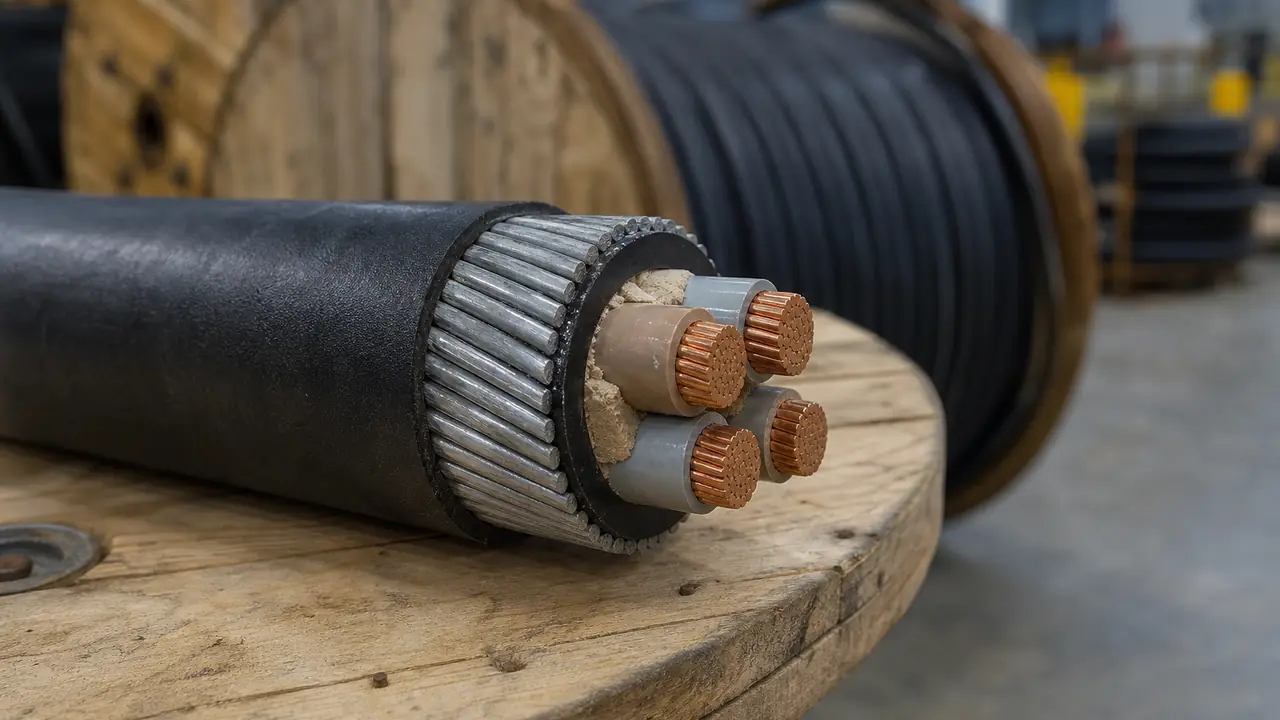
What this cable is
An armoured power cable is an LV XLPE cable with a metal layer over the laid-up cores that protects them from crushing, impact and digging. The reference construction on this page is the four-core 35 mm2 Cu/XLPE/PVC/STA/PVC cable from a partner plant catalogue (YJV22 in Chinese designation): annealed copper conductors, 0.9 mm of XLPE insulation, fillers and a 1.2 mm PVC inner sheath, 0.2 mm steel tape armour, and a 1.8 mm PVC outer sheath. It is about 30 mm overall and weighs about 2,067 kg per kilometre. The catalogue gives the tape thickness but not the number of layers; two helically applied tapes are common in the industry, and the spec sheet fixes it for your order.
Armour handles mechanical force from outside. It does not make a cable suitable for heavy pulling loads or vertical drops without support, and it is not a fire barrier. Current rating is set by installation method and grouping under IEC 60364-5-52, BS 7671 or NEC as applicable, confirmed by your project engineer; we do not publish figures.
STA, SWA and AWA compared
All three are recognised armour types, but they suit different markets and circuits. Steel tape armour is in the partner catalogue and allowed under IEC 60502-1. Steel wire armour is the usual specification in the UK, the Middle East and many Commonwealth markets. Aluminium wire armour is used on single-core AC cables, because steel around a single conductor carrying alternating current heats up through induced currents.
| Armour | Typical standard | Cores | Strengths | Sourcing note |
|---|---|---|---|---|
| STA, steel tape | IEC 60502-1, GB/T 12706.1 | Multicore | Crush resistance, compact, common in Asia | Partner catalogue reference |
| SWA, steel wire | BS 5467 (PVC), BS 6724 (LSZH), IEC 60502-1 | Multicore | Impact and some tensile strength, armour used as protective conductor where design allows | Matched to plants running SWA lines |
| AWA, aluminium wire | BS 5467, BS 6724, IEC 60502-1 | Single core AC | Non-magnetic, avoids eddy current heating | Matched to plants running AWA lines |
In practice, buyers order armoured cable for three kinds of route. Direct burial between buildings, to pumps, street lighting or solar inverter stations, where a spade or a stone can reach the cable. Industrial trays and trenches in plants, mines and oil and gas sites, where forklifts, falling objects and vibration are part of daily life. And exposed runs on walls and structures outdoors, where an unprotected sheath would be damaged during maintenance. On a dry, protected tray inside an office building, armour usually adds weight, diameter and cost without much benefit, and an unarmoured LV XLPE cable in suitable containment is often the better choice. Your engineer decides per route. The SWA vs STA article and the armour and screens page go further into the trade-offs.
The quality risk buyers should know
Armoured cable has a documented counterfeit pattern. BASEC has warned about SWA cable whose effective conductor size was up to two sizes smaller than marked, with both conductor and armour resistance out of limits. The sheath looks the same; only measurement shows it. For every drum the desk asks for the conductor DC resistance at 20 C against IEC 60228 (0.524 ohm/km for 35 mm2 copper Class 2), checks armour wire count and diameter or tape thickness against the spec sheet, and measures insulation thickness on samples. Only cable printed with the BASEC name is a BASEC approved product, and an approval held by the partner plant is checked in BASEC's public database per order.
What you can change
- Armour type: STA from the reference plant; SWA or AWA via plants that run those lines.
- Outer sheath: PVC as standard; LSZH for BS 6724 or public buildings with fire tests per report; PE for wet ground.
- Core identification: brown, black, grey and blue for IEC and UK markets, or the local convention.
- Marking: your brand, construction, standard, year and metre marks on the outer sheath.
Copper or aluminium conductors can both be armoured; for aluminium see aluminium power cable, where an STA version (YJLV22) is in the catalogue range.
Packing, MOQ and lead time
Armoured cable is heavier and stiffer than unarmoured cable of the same size, so drums are larger for the same length and the drum plan follows weight and bending radius. As a reference, 500 m of the 4x35 mm2 STA cable weighs roughly 1,034 kg net before the drum. Plant listings commonly show a minimum of around 500 m per size. The armouring and second sheathing pass add a production step, and lead time depends on copper booking, the slot and routine testing; it is confirmed in writing for each order. See MOQ and lead time and packaging and drums, or send your BOQ through the quote form.