
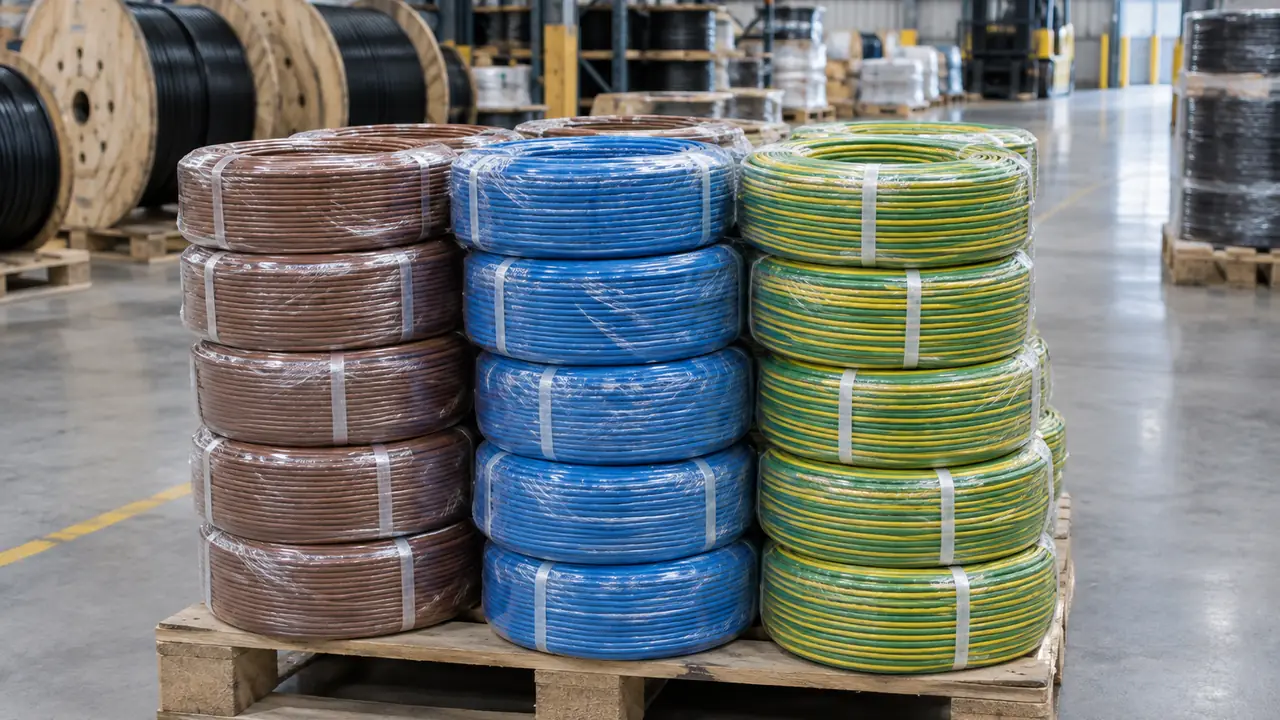
What this wire is
Building wire is a single copper conductor with a PVC insulation layer and no sheath, pulled into conduit or trunking or laid inside panels and distribution boards. The reference construction on this page is 450/750 V single-core 2.5 mm2 wire with a 7-strand Class 2 conductor, the 60227 IEC 01 type sold in Europe as H07V-R, from a partner plant catalogue: conductor diameter about 2.01 mm, PVC insulation 0.8 mm, overall diameter 3.3-4.0 mm and about 34 kg per kilometre. The 450/750 V rating means 450 V to earth and 750 V between conductors. PVC insulation runs at 70 C continuously.
Because building wire is almost all copper plus a thin PVC layer, its price follows copper closely and its quality is mostly about two things: a conductor that is the size marked, and insulation that is the thickness the standard requires. Both are easy to check and easy to cut, which is why the desk asks for records on both. The wire vs cable article explains where this product sits.
Conductor classes: solid, stranded and flexible
The same 2.5 mm2 wire comes in three conductor forms under IEC 60228, and the designation tells you which one you are buying.
| Designation | Conductor | Construction note | Typical use |
|---|---|---|---|
| H07V-U | Class 1 solid copper | 2.5 mm2: 0.8 mm PVC, OD approx. 3.4-3.6 mm, approx. 30-34 kg/km | Fixed wiring in conduit |
| H07V-R | Class 2 stranded copper | Reference model above; 7 strands on 2.5 mm2 | Fixed wiring, larger sizes |
| H07V-K | Class 5 flexible copper | 2.5 mm2: 0.8 mm PVC, OD approx. 3.4-3.6 mm | Inside boards and where bending is needed |
| THHN/THWN-2 12 AWG (US) | Solid or 19-strand copper | 16 mil PVC plus 5 mil nylon; OD 0.122 in solid, approx. 0.130 in for 19 strands, approx. 34 kg/km | US conduit wiring to UL 83 |
| XHHW-2 (US) | Stranded copper | XLPE insulation to UL 44 | US feeders and wet locations |
Resistance is the quickest size check. For 2.5 mm2, IEC 60228 sets a maximum DC resistance at 20 C of 7.41 ohm/km for Class 1 and 2 copper and 7.98 ohm/km for plain Class 5. Ask for it on every batch; see H07V-U vs H07V-R vs H07V-K for the choice between forms.
Systems are not interchangeable
American wire is sized in AWG and listed to UL 83 or UL 44; IEC-type wire is sized in mm2 to IEC 60227 and its European equivalent. A 12 AWG wire is not a 2.5 mm2 wire with a different label, and inspectors in each market accept only their own system. US projects usually require UL (or other NRTL) listed products to satisfy the AHJ, so the listing held by the partner plant for that construction is checked in the certifier's public database per order; NEC 310.3 sets 14 AWG as the minimum copper size. In the EU, wire for permanent installation needs a CPR class declared on the DoP. In Thailand, TIS 11 Part 3 for unsheathed fixed-wiring cable has been mandatory since 30 July 2013, and the desk works with a southwest China partner plant with TIS 11 model experience.
What you can change, and what you should not
- Colour: brown, black, grey, blue and green-yellow for IEC markets; US and Thai conventions on request. See cable core colour codes.
- Print: your brand, designation, size, voltage, standard and metre marks along the insulation.
- Coils: coil length, shrink wrap, carton and label artwork for retail shelves.
Conductor class and insulation thickness are set by the standard. The nylon jacket belongs to THHN/THWN-2 only and is not added to IEC wire. Current rating is not published here; it depends on the installation method under IEC 60364-5-52, BS 7671 or NEC as applicable, confirmed by the project engineer.
Packing, MOQ and the order route
100 m coils are common for building wire and are confirmed per order; US THHN is commonly put up on 500 ft and 2,500 ft reels, so length units are written on the spec sheet to avoid confusion between metres and feet. Coils are labelled with designation, size, colour and length, and cartons are marked for the destination warehouse. MOQ is set per size and colour by the plant and confirmed in writing; see MOQ and lead time.
- Send the system, sizes, colours, coil length and quantities through the quote form.
- The desk shortlists partner plants that make that system and checks their listings or reports.
- The spec sheet fixes conductor class, insulation thickness, print text and coil format.
- Resistance and insulation records are collected, and coils are checked for length, print and labels before loading.