
The short answer
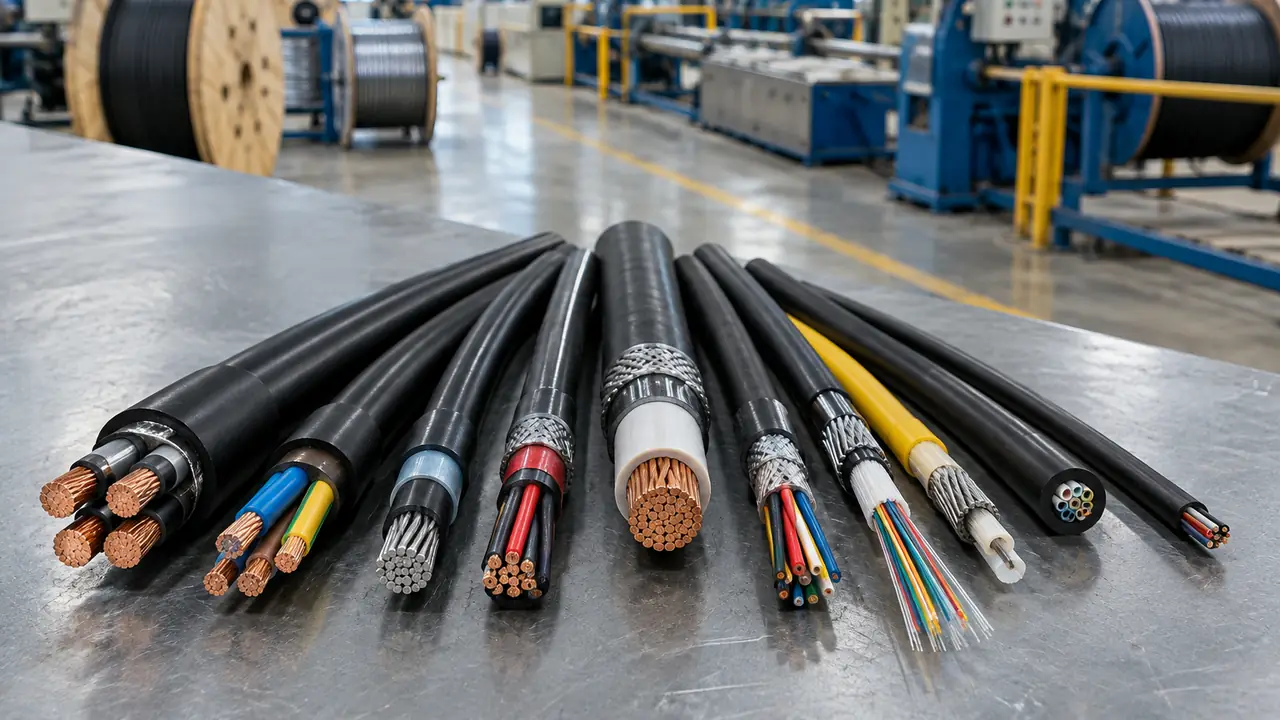
A wire, in the sense used by cable standards and factories, is usually a single conductor with or without insulation: one solid or stranded copper or aluminium conductor, perhaps with a PVC layer around it. A cable is an assembly: one or more insulated conductors held together, usually under a sheath, sometimes with screens, armour, fillers and tapes. A 2.5 mm2 single-core PVC conductor pulled into conduit is building wire. Three of those cores twisted together under a PVC sheath become a flexible cord or a sheathed cable.
The distinction is not perfect. Americans say "wire" for THHN building wire and "cable" for NM-B or tray cable; British buyers say "cable" for almost everything; Chinese catalogues call single-core PVC conductors 电线 (wire) and sheathed constructions 电缆 (cable). What matters for a buyer is not the word but the construction behind it, which is why the desk always asks for the designation or standard rather than a description.
How standards draw the line
The IEC 60227 family covers PVC insulated cables rated up to 450/750 V, and it includes both unsheathed single-core conductors for fixed wiring (the 60227 IEC 01 type, sold in Europe as H07V-U, H07V-R or H07V-K) and sheathed flexible cords such as 60227 IEC 53 (H05VV-F). IEC 60502-1 covers power cables from 1 kV, which are almost always sheathed assemblies. Thailand's TIS 11 follows the IEC 60227 split: Part 3 for unsheathed cables for fixed wiring, Part 4 for sheathed cables for fixed wiring and Part 5 for flexible cords, with Parts 3 and 4 mandatory since 30 July 2013.
| Product | Typical standard | Sheath | Rated voltage |
|---|---|---|---|
| Single-core building wire | IEC 60227 (60227 IEC 01), TIS 11 Part 3, UL 83 (THHN) | None; THHN adds a nylon jacket | 450/750 V; 600 V for THHN |
| Flexible cord | IEC 60227 (60227 IEC 53), EN 50525-2-11 (H05VV-F) | PVC | 300/500 V |
| Control cable | National standards such as GB/T 9330 | PVC | 450/750 V |
| LV power cable | IEC 60502-1 | PVC, LSZH or PE | 0.6/1 kV |
| MV power cable | IEC 60502-2 | PVC or PE over metallic screen | 3.6/6 to 18/30 kV |
Read more about each family in the cable types guide.
Why the difference changes your quote
The first practical effect is price structure. Copper and aluminium make up roughly 80% of the cost of a typical wire or cable product according to listed manufacturers' disclosures, but the share differs. A single-core building wire is almost all conductor plus a thin PVC layer, so its price moves almost one for one with copper. A sheathed, armoured cable carries fillers, bedding, armour and a thick sheath, so compounds, steel and processing take a bigger slice. Two quotes per metre are only comparable when the constructions are the same.
The second effect is packing. Building wire usually ships in coils, often 100 m, that a retailer can put on a shelf. Power cable ships on drums whose size is set by the cable's weight and diameter; the reference 0.6/1 kV 4x25 mm2 XLPE cable on our LV power cable page weighs about 1,292 kg per kilometre. Coils and drums change freight, handling and how much you have to order.
The third effect is testing. Wire is checked mainly for conductor resistance, insulation thickness and a voltage or spark test. Cables add sheath thickness, overall diameter, and for screened, armoured or medium-voltage constructions, armour resistance, partial discharge and other routine tests. A buyer who asks for "wire" but needs a sheathed cable can end up with the wrong test plan as well as the wrong product.
Customs and documents
Most insulated wire and cable falls under HS heading 8544. Within it, conductors for up to 1 kV without connectors are commonly declared under 8544.49, conductors above 1 kV under 8544.60, coaxial cable under 8544.20 and optical fibre cable made of individually sheathed fibres under 8544.70. The heading does not care whether you call the product wire or cable; it cares about voltage, connectors and construction. Your customs broker confirms the code, and the spec sheet should describe the construction precisely enough for them to do it.
How to describe what you need
A useful brief names five things, whatever word you prefer:
- Conductor: copper or aluminium, cross-section in mm2 or AWG, and class (solid, stranded or flexible).
- Insulation: PVC, XLPE or another compound, and the rated voltage.
- Assembly: number of cores, screens or armour, and the sheath material.
- Standard: the standard or market the cable must meet, such as IEC 60502-1, BS 6004, UL 83 or TIS 11.
- Quantity and packing: total metres per size and the coil or drum length you want.
With those five, the desk can match a plant and write a spec sheet. Without them, every supplier fills the gaps differently. The cable RFQ checklist lists the full set of fields, and the quote form asks for them step by step.
Where the words cause real mistakes
Three mix-ups come up again and again. A buyer asks for "4 mm solar wire" and receives a cable with a 4 mm overall diameter instead of a 4 mm2 conductor; always give cross-sections in mm2 or AWG. A buyer orders "network wire" and receives copper-clad aluminium, which category cable standards do not allow; category cable needs solid copper conductors. A buyer asks for "armoured wire" for burial and receives a flexible cord with a braid; armour for burial means steel wire or steel tape over a bedding layer, as described on our armoured cables page.
Each of those mistakes is avoided by writing the construction down. The vocabulary can stay informal in an email, as long as the spec sheet that follows is exact, and that is the job the desk does before any copper is booked. If you are comparing offers already, the cable problems guide shows what to check first when two quotes for the same description are far apart.