
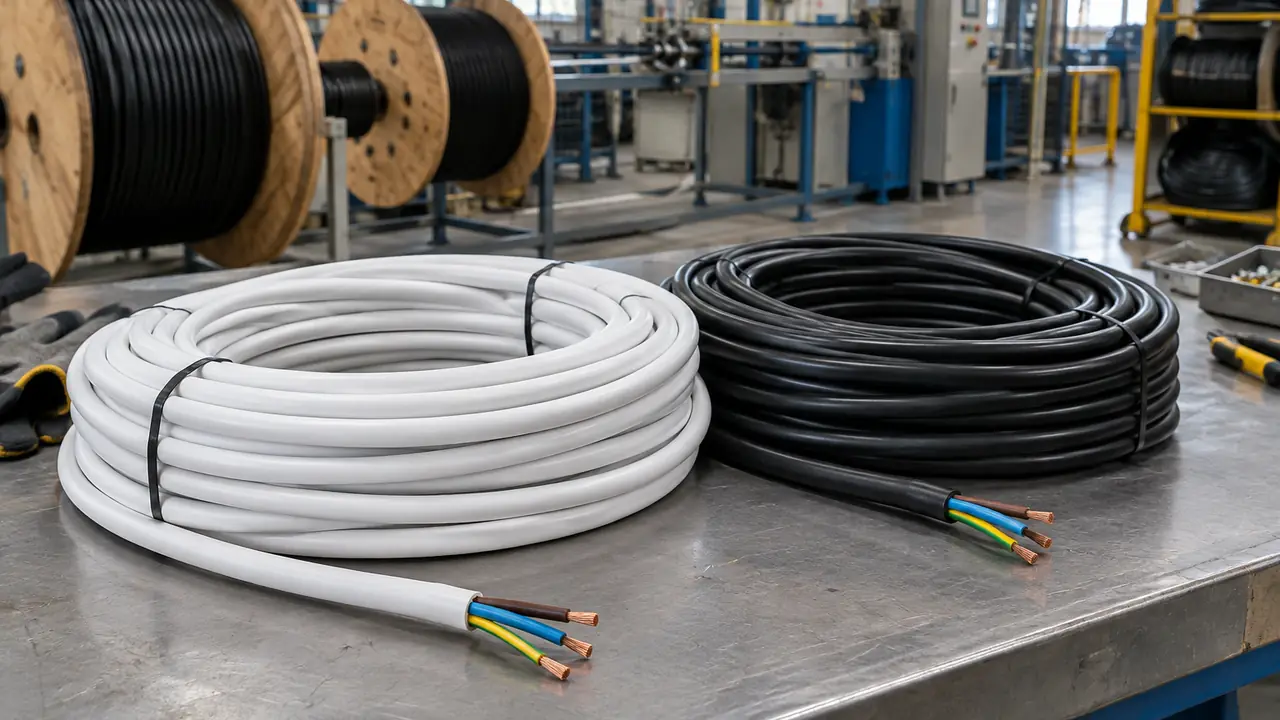
What this cord is
A flexible cord is a sheathed cable with fine-stranded conductors, made to move: the lead from an appliance, an extension lead, the supply to a portable tool or a light fitting. The reference construction on this page is the 300/500 V three-core 1.5 mm2 PVC cord, the 60227 IEC 53 type sold in Europe as H05VV-F 3G1.5, from a partner plant catalogue: Class 5 annealed copper conductors with individual wires of 0.26 mm or less, 0.7 mm PVC insulation, a 0.9 mm PVC sheath and an overall diameter of 7.4-9.4 mm. Weight across public datasheets runs from about 95 to 121 kg per kilometre, so the figure for your order is taken from the plant's datasheet.
The 3G in the designation means three cores including a green-yellow earth; 3X would mean three cores without one. The 300/500 V rating is lower than building wire's 450/750 V, because cords connect equipment rather than form part of the fixed installation. Sheath thickness matters: 0.9 mm is the value for 3G1.5, while 0.8 mm belongs to smaller constructions such as 2x1.5 and 3x1.0, and a quote showing 0.8 mm on 3G1.5 should be questioned.
Sizes and constructions
| Construction | Typical sizes | Typical use |
|---|---|---|
| 2-core, 300/500 V | 0.75-2.5 mm2 | Double-insulated appliances, lamps |
| 3-core with earth (3G) | 0.75-2.5 mm2; reference 3G1.5 | Appliances, extension leads, power tools |
| 4- and 5-core | 0.75-2.5 mm2 | Small three-phase equipment, control of portable machines |
| Rubber cords H05RN-F / H07RN-F | Per datasheet | Outdoor, construction sites, heavier duty; matched to a separate plant |
PVC cords suit indoor and light-duty use. Where the cord is dragged, used outdoors or in the cold, rubber constructions to IEC 60245 are the usual choice, and the desk matches a plant that makes them; see rubber vs PVC flexible cables.
Checking the copper in a cord
Fine-stranded cords are where short copper is hardest to see. Fewer or thinner wires in each core look the same once the sheath is on. The check is conductor DC resistance at 20 C against IEC 60228 Class 5: 13.3 ohm/km maximum for 1.5 mm2 and 7.98 ohm/km for 2.5 mm2 plain copper. The desk asks for these records per batch and can have cores weighed or tested by a third-party lab. Copper-clad aluminium conductors are a known substitution in low-price cords; they are lighter, show aluminium when scraped and can be detected by XRF. Read more in counterfeit cable signs.
Private label and finished leads
- Sheath colour: white, black or grey are common; other colours by agreement with the plant.
- Print: your brand, designation, size, voltage and standard along the sheath; metre marks if required.
- Coils and cartons: coil length, shrink wrap, label artwork and carton marking for retail.
- Fitted leads: cords with plugs or connectors are a different product with plug standards of their own; they are quoted separately and usually classified under a different HS heading.
Approval marks such as HAR belong to the partner plant and the specific construction, and are checked with the certifier per order. Where cords are sold into the EU, RoHS 2 applies; ask the plant for the SVHC declaration your customer requires. The OEM and private label page covers print approval.
Standards and market notes
IEC 60227 covers PVC insulated cables up to 450/750 V, and its Part 5 type 60227 IEC 53 is the international reference for this cord. In Europe the harmonised designation H05VV-F follows EN 50525-2-11, and most Middle East and African buyers use the same naming. Thailand's TIS 11 has a separate part for flexible cords, and the desk confirms the current status of that part with your importer before ordering. In China, CCC covers PVC and rubber insulated cables of 450/750 V and below, which includes cords made for the domestic market; export lots follow the destination's rules instead. Market access schemes such as KEBS PVoC in Kenya, SONCAP in Nigeria or SABER in Saudi Arabia apply per shipment and are handled with your importer of record. The cable standards guide maps these routes.
Current rating for a cord depends on how it is used, its length and the equipment standard it is fitted to. The desk does not publish ratings; the equipment designer or project engineer sets the size, and the desk supplies the construction they specify.
Ordering
Cords commonly ship in 100 m coils, confirmed per order; longer reels of 500 m or 1,000 m are available for cut-to-length users. MOQ depends on size, colour and coil format, and is confirmed in writing for each order; see MOQ and lead time. Send cores, sizes, sheath colour, coil format and quantities through the quote form.