
The basic trade-off
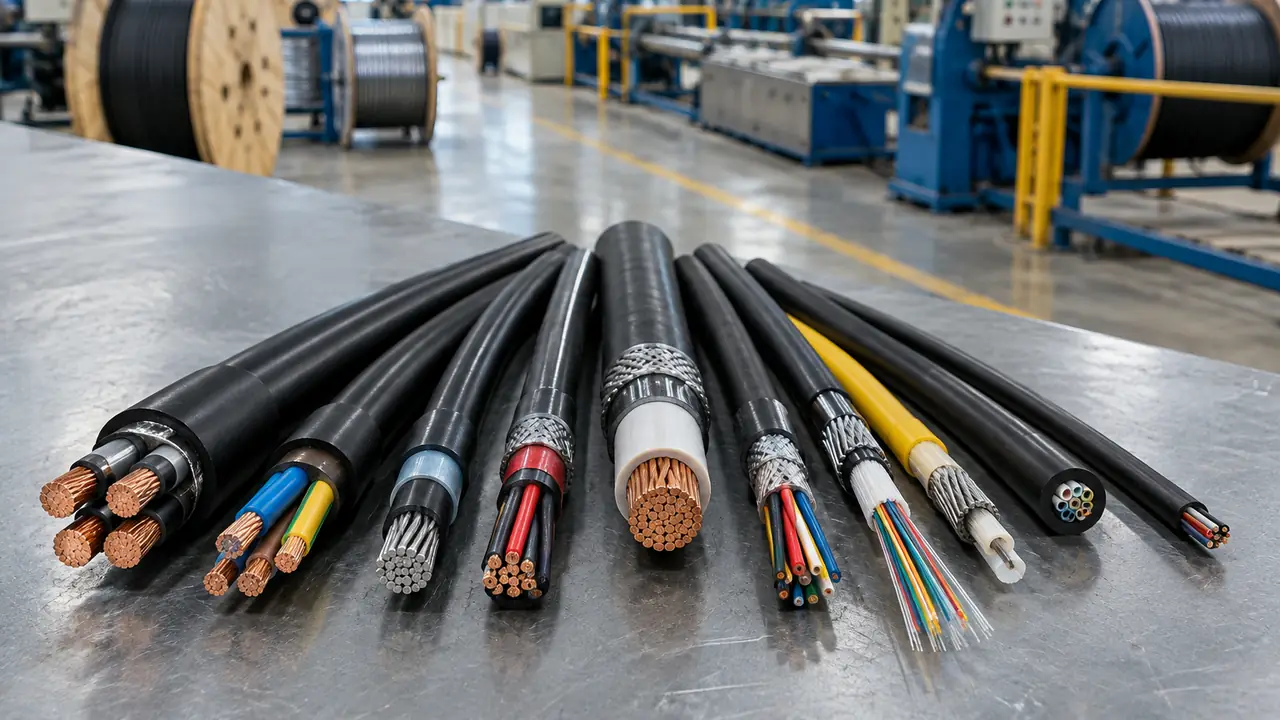
A multicore cable puts all the conductors of a circuit inside one sheath: three phases, perhaps a neutral and an earth. It is laid in one pass, glanded once at each end and carries one drum label. A single-core cable carries one conductor per sheath, so a three-phase circuit needs at least three cables laid together.
For small and medium sizes, multicore is usually simpler and cheaper to install. As the conductor size grows, a multicore cable becomes heavy, stiff and hard to bend, pull and terminate, and the balance tips towards single-core cables. Where exactly the crossover lies depends on the project, the installation route and the terminations available; the designer makes that call, and the buyer's job is to make sure the order matches the design.
For distributors and wholesalers the question looks different. Stock is held for many projects at once, so the choice is about which formats customers ask for most. Multicore cables in the common sizes turn over steadily and can be cut to length from stock drums. Large single-core cables are usually project items, ordered against a specific BOQ in matched lengths, and are rarely worth holding unless the distributor serves a steady flow of switchboard and transformer work. A sensible stock plan keeps multicore sizes on the shelf and sources single-core feeders per project, with drum lengths agreed before the order is placed. The desk can split one enquiry along those lines so that stock lines and project lines are quoted and scheduled separately.
Size ranges and what plants make
Partner plant catalogues show how the two families overlap. The LV power cable range runs from 1.5 to 630 mm2 in 1 to 5 cores and in reduced-neutral forms such as 3+1 and 3+2. Aluminium cables run from 1x10 to 630 mm2 in single core and 10 to 400 mm2 in multicore. On the MV side, IEC 60502-2 cables in the reference catalogue run from 25 to 630 mm2 single core and 25 to 400 mm2 three core. The largest sizes, in other words, are single-core only.
| Aspect | Multicore | Single-core |
|---|---|---|
| Typical use | Small and medium circuits, final distribution, control | Large feeders, transformer and switchboard connections, MV circuits |
| Armour | SWA or STA over all cores | AWA (aluminium wire) for AC circuits; unarmoured in ducts or trays |
| Laying | One cable per circuit | Three or more cables in trefoil or flat formation |
| Bending and pulling | Stiffer at large sizes | Each cable more flexible and lighter |
| Terminations | One gland per end, cores spread inside the box | One gland per cable; non-magnetic gland plates for AC |
| Drums | One drum per length | Matched drums per phase, same lengths |
Armour: why single-core AC cables use aluminium
In a multicore cable, the magnetic fields of the three phase currents largely cancel inside the cable, so steel armour around all the cores is fine. Steel wire armour (SWA) is the usual choice for multicore cables to BS 5467 and BS 6724, and steel tape armour (STA) is the construction of the reference 0.6/1 kV 4x35 mm2 cable on our armoured cables page.
A single-core cable carrying AC is different. Its field does not cancel, and a ring of steel around one conductor would heat up through eddy currents and magnetic losses. Single-core armoured cables for AC circuits therefore use aluminium wire armour (AWA), which is non-magnetic. The same logic applies at the gland plate, where steel plates around single-core AC cables are usually replaced with non-magnetic plates. The armour and screens page and our post on AWA armour on single-core cables go into more detail.
Laying and bonding
Single-core cables of one circuit are laid close together, either in trefoil (a tight triangle) or in flat formation. The formation affects heat dissipation, induced voltages on screens and armour, and the forces between cables in a short circuit, which is why cable cleats rated for the fault level are used on large single-core runs. All of these are inputs to the current rating calculation under IEC 60364-5-52, BS 7671 or NEC as applicable, done by the project engineer.
Screens and armour on single-core cables also need a bonding arrangement, because currents can circulate in them when both ends are earthed. The designer chooses the arrangement; the buyer needs to know it only to make sure the cables, glands and earthing accessories ordered match it. Multicore cables avoid most of this, which is part of their appeal for smaller circuits.
Cost per circuit, not per metre
Comparing single-core and multicore on price per metre is misleading. A three-phase circuit in single-core cable needs three or four times the cable length, three or four sheaths instead of one, and separate armour on each cable if armour is required. Against that, single-core cables are easier to pull through long ducts, need smaller drums per cable and can sometimes avoid jointing on long runs because each drum carries a longer length. The right comparison is cost per circuit metre, including glands, cleats and installation time.
Weight shows the scale. The reference 0.6/1 kV Al/XLPE/PVC 4x95 mm2 cable on our aluminium cables page weighs about 1,907 kg per kilometre in one sheath. The same circuit in single-core cables spreads that metal over four sheaths and four drums, each lighter and easier to handle on site, but with more sheath compound in total.
What to put on the order
- State the core configuration: 1x240 mm2, 3x95 mm2, 3x150+70 mm2 and so on, exactly as in the BOQ.
- State the armour per type: AWA for single-core AC, SWA or STA for multicore, or unarmoured.
- Match lengths per phase: for single-core circuits, order drums in sets of equal length so phases can be laid together.
- Mark phases if required: single-core cables can carry phase identification in the sheath print or a coloured stripe, agreed on the spec sheet.
- Check drum and handling limits: large multicore drums can exceed site lifting capacity; see our post on cable drum basics.
Send the BOQ through the quote form. The desk confirms core configuration, armour and drum sets in writing with the plant before production.