
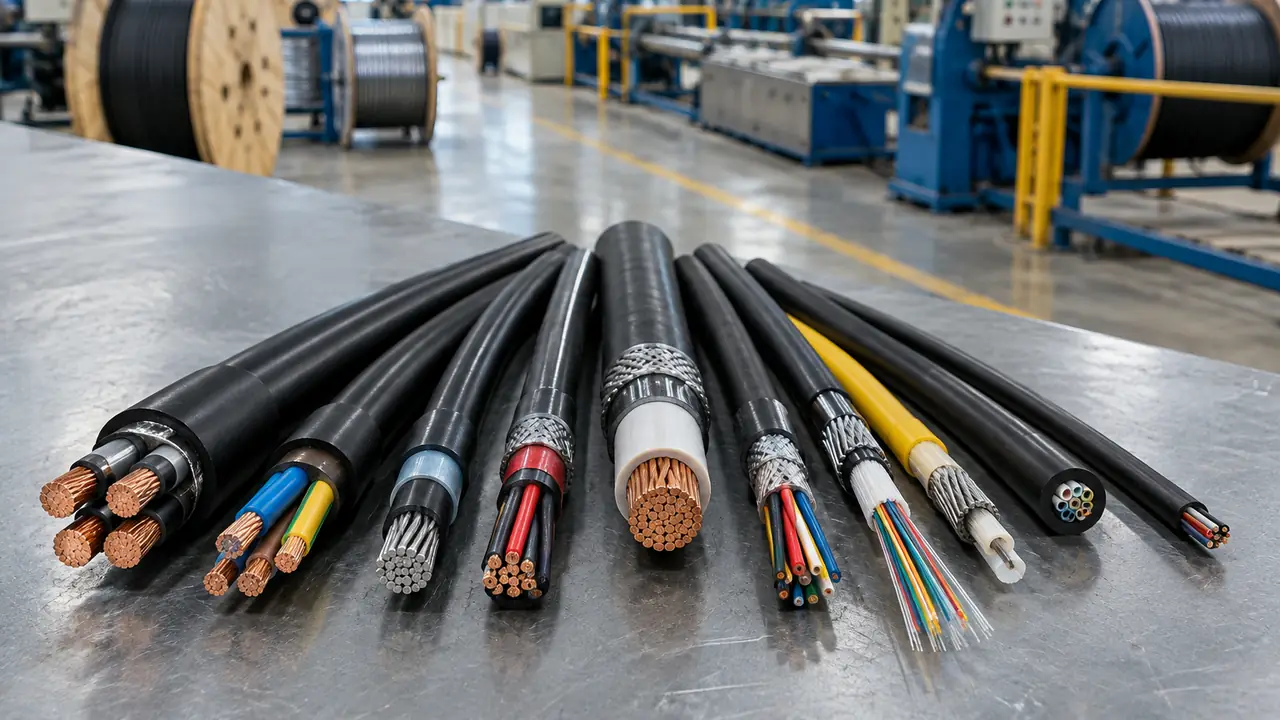
Conductors
- 1. Conductor
- The metal part that carries current, usually annealed copper or aluminium. Specified by material, cross-section and class.
- 2. Cross-section (mm2)
- The nominal conductor area, such as 2.5 mm2 or 95 mm2. Not the overall diameter of the cable.
- 3. AWG and kcmil
- US size systems. AWG numbers get smaller as the conductor gets larger; kcmil is used above 4/0 AWG.
- 4. Conductor class
- The IEC 60228 grade of stranding: Class 1 solid, Class 2 stranded, Class 5 flexible, Class 6 extra flexible.
- 5. DC resistance
- The maximum resistance per kilometre at 20 C set by IEC 60228 for each size and class, for example 0.727 ohm/km for 25 mm2 copper Class 2. The best single check that a conductor carries enough metal.
- 6. Compacted conductor
- A stranded conductor rolled to close the gaps between wires, giving a smaller, smoother diameter for the same cross-section.
- 7. Tinned copper
- Copper wires coated with tin, used in solar PV cable such as H1Z2Z2-K and in many flexible and marine cables.
- 8. CCA
- Copper-clad aluminium: an aluminium core with a thin copper layer. Category network cable requires solid copper conductors, so CCA sold as category cable is counterfeit. See CCA vs copper.
Insulation and sheaths
- 9. Insulation
- The extruded layer around each conductor that holds the voltage.
- 10. PVC
- Polyvinyl chloride. As insulation, rated for a 70 C conductor temperature; also the most common sheath compound.
- 11. XLPE
- Cross-linked polyethylene insulation, rated 90 C continuous and 250 C in a short circuit.
- 12. LSZH
- Low smoke zero halogen. Sheath or bedding compounds tested for smoke density to IEC 61034 and for acid gas to IEC 60754.
- 13. Sheath (oversheath, jacket)
- The outer protective layer that carries the printed legend.
- 14. Bedding (inner sheath)
- An extruded layer over the laid-up cores that supports the armour.
- 15. Fillers and binder tape
- Materials that fill the gaps between cores to make the cable round, held by a wrapped tape.
- 16. Semiconductive screen
- Thin conductive layers under and over the insulation of MV cables that smooth the electric field.
The insulation and sheaths page compares these compounds in detail.
Screens, armour and construction
| Term | Meaning |
|---|---|
| 17. Metallic screen | Copper tape or wires over the insulation of MV cables, holding the outer surface at earth potential and carrying fault current |
| 18. Braid screen | Woven copper wires over the cores of instrumentation or control cables, reducing electrical interference |
| 19. SWA | Steel wire armour, the usual mechanical protection for multicore power cables |
| 20. AWA | Aluminium wire armour, used on single-core AC cables because it is non-magnetic |
| 21. STA | Steel tape armour, a permitted armour form in IEC 60502-1 |
| 22. Mica tape | A tape under the insulation of fire-resistant cables that helps maintain circuit integrity in a fire test |
| 23. U0/U rating | Rated voltage conductor-to-earth / conductor-to-conductor, such as 0.6/1 kV or 8.7/15 kV |
| 24. Designation | The coded description of a cable, such as Cu/XLPE/SWA/PVC 4x35 mm2, YJV22 or H07V-R |
Designations are decoded in our post on reading cable designations.
Fire and compliance
- 25. Flame-retardant
- Limits flame spread in a fire test, such as IEC 60332-1-2 for a single cable or IEC 60332-3 for bunched cables, per test report.
- 26. Fire-resistant (circuit integrity)
- Keeps working for a stated time in a fire test such as IEC 60331, BS 6387 CWZ or BS 8519, per test report. Different from flame-retardant.
- 27. CPR class
- The EU reaction-to-fire class under EN 50575, from Aca to Fca with s, d and a additional classes, such as Cca-s1,d1,a1.
- 28. DoP
- Declaration of performance: the document in which the manufacturer declares the CPR class. The CE marking goes on the label with it.
- 29. AVCP system
- The EU route for assessing performance: System 1+ for Aca to Cca, System 3 for Dca and Eca, System 4 for Fca.
- 30. Listing or approval
- A certification such as a UL listing or BASEC approval held by the partner plant for a specific construction, checked in the certifier's public database per order.
- 31. HS code
- The customs classification. Most insulated cable falls under heading 8544; your customs broker confirms the subheading.
- 32. RoHS
- The EU directive 2011/65/EU restricting hazardous substances, which covers cables.
More on fire terms is on the fire performance classes page.
Testing and commercial terms
- 33. Routine test
- A test on every drum, such as conductor resistance and voltage test.
- 34. Sample test
- A test on samples taken from production at a set frequency, such as thickness and dimensional checks.
- 35. Type test
- A test done once to prove a construction meets its standard, repeated when the design changes.
- 36. Partial discharge
- Small electrical discharges inside MV insulation; measured as a routine test to IEC 60885-3.
- 37. Pre-shipment inspection
- A check of drums, print, dimensions and records before loading, often sampled to ISO 2859-1.
- 38. Copper base and adjustment
- Pricing based on the copper price plus processing, with a formula linking the price to LME copper on long contracts.
- 39. MOQ
- Minimum order quantity, usually set in metres per size, drums or boxes and confirmed in writing per order.
- 40. Drum plan
- The list of lengths per drum, drum type, tolerance and labels for each size on an order.
Using the glossary on a real quote
When a quote arrives, read it with these terms in mind: does it state the conductor class and resistance, the insulation compound, the armour type, the standard, the fire class where needed, the test records offered and the drum plan? Anything missing is a question for the supplier before price is compared.
Watch for terms used loosely. "Fire cable" can mean flame-retardant, fire-resistant or simply LSZH, three different properties with different tests. "Full size" says nothing unless the DC resistance record backs it up. "Armoured" can mean steel wire, steel tape or a braid, and only the first two are usual for burial. "Certified" is only meaningful when the certificate is named, held by the plant for that exact construction and visible in the certifier's public database. When a supplier uses a term in a way that does not match the definitions above, ask what they mean and record the answer on the spec sheet.
The cable RFQ checklist turns the same terms into a list of fields, MOQ ranges are on the MOQ and lead time page, and the quote form collects them step by step.