
What rubber flexible cords are
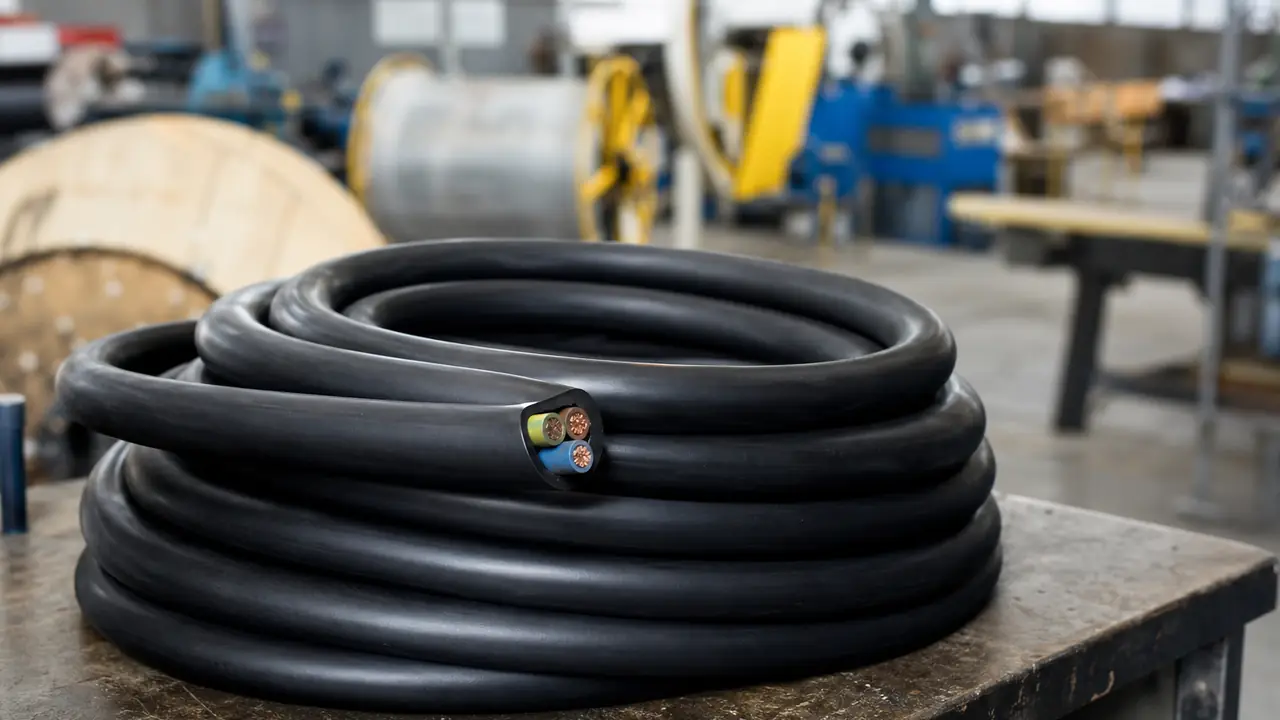
Rubber flexible cords are the heavy-duty cousins of PVC flexible cords: fine-stranded copper cores in thermoset rubber insulation, sheathed in black polychloroprene rubber that tolerates weather, abrasion and light oil. Where a PVC cord serves lamps and office appliances, a rubber cord serves building sites, gardens, farms, pumps, workshops and stage or port machinery. The reference construction on this page, taken from public datasheets, is H07RN-F 3G1.5: a Class 5 fine-strand copper conductor to IEC 60228, thermoset rubber core insulation, three cores laid up with fillers and a black polychloroprene sheath of the EM2 type. Datasheets list about 9.3 mm overall and about 125 kg/km; the 3G2.5 size lists about 11.1 mm and about 185 kg/km.
H05RN-F vs H07RN-F
The prefix sets the rated voltage and, in practice, the duty. H05RN-F is rated 300/500 V and datasheets list it mainly in the 1.0 and 1.5 mm2 sizes, for light portable equipment in damp places. H07RN-F is rated 450/750 V, covers the 1.5 to 2.5 mm2 sizes that move real power, and is what buyers usually mean by heavy-duty outdoor cord. Both carry a G suffix when a green-yellow earth core is included; x versions omit the earth.
| Type | Rated voltage | Sizes listed | Typical duty |
|---|---|---|---|
| H05RN-F | 300/500 V | 1.0 and 1.5 mm2, 2-4 cores | Light portable appliances in damp areas |
| H07RN-F | 450/750 V | 1.0-2.5 mm2 and above, 2-5 cores | Site distribution, pumps, agricultural and stage equipment |
H05RN-F 3G1.5 lists about 8.2-8.9 mm and about 118 kg/km across datasheets. Where a datasheet quotes current tables, they apply to defined installation conditions; your engineer or installer confirms the figure for the real use, and the desk does not publish ratings.
Construction and the EN 50525-2-21 framework
EN 50525-2-21 is the harmonised specification for thermoset-sheathed flexible cords, the framework behind both types. Under it, the conductor is Class 5 to IEC 60228; the core insulation is thermoset rubber, listed by plants as EI4 or EI7 depending on the compound; core colours follow the harmonised scheme, blue and brown with green-yellow earth on G versions; and the sheath is polychloroprene rubber of the EM2 type, black as standard. In the IEC system the nearest designation is 60245 IEC 57 under IEC 60245, which is the route for markets outside the harmonised area. Flame behaviour is limited to the single-cable vertical flame test, proven per test report for the construction ordered.
The HAR mark belongs to the manufacturer
HAR is the CENELEC harmonisation mark. The manufacturer signs a mark licence with a certification body, has the construction type-tested against the harmonised specification, accepts routine factory surveillance, and then prints HAR with the body identifier on the sheath. Two consequences matter to buyers. The mark is held by the manufacturer for that construction: it does not transfer to another plant, and it is not something a sourcing desk can add afterwards. And the licence is verifiable: the desk asks for the licence number and checks it in the certification body's public database per order. For sales into Europe buyers usually require HAR, or the building CPR route where the cord is permanently installed; the same construction without HAR is normally offered for other markets against the IEC designation.
Bending radius and outdoor, site use
Manufacturer datasheets typically set the minimum bending radius at 3 times the outer diameter for cords under 12 mm OD and 4 times above, so the 3G1.5 reference cord bends in a radius of roughly 30 mm; treat it as an installation limit. Outdoor duty is where the polychloroprene sheath earns its place: site distribution boards feeding tools, submersible pump sets (some makers quote an AD8 immersion class for pump duty), agricultural equipment, and temporary stage and port power. Two practical checks before ordering: makers quote low-temperature limits for mobile and fixed use separately on the datasheet, and the same size can differ 2-3 mm in overall diameter between makers, so size cord grips and glands to the datasheet of the cord you buy, not to a generic table.
What you can change
- Conductor tinning: bare copper in the reference rows; tinned strands offered for corrosive duty, confirmed per order.
- Sheath and print: black as standard; your brand, type, standard, voltage and metre marks on the coil length.
- Coil lengths: 100 m coils are the common delivery form; other lengths by agreement.
- Core counts: 2-5 cores with or without earth, within the datasheet range.
Insulation and sheath compounds and their thicknesses follow EN 50525-2-21 and should not move to save cost; if a quote looks low, check conductor resistance and wall thickness against the standard first.
MOQ and how the desk quotes
Rubber cords are quoted per size and colour, with black 100 m coils as the common stock form; MOQ and lead time are confirmed in writing for each order. The desk shortlists partner plants that make the EN 50525-2-21 construction and, where your market needs it, hold a HAR licence in their own name, then checks print, metre marks and coil length before loading; see testing and inspection and private label cable. Compare with the PVC cord line on the flexible cords page, or read rubber vs PVC flexible cables. Send sizes, cores, metres and port through the quote form.